Clinical trial protocol checklist work should begin before the first full draft. For a Phase I or Phase II study, the sponsor should resolve the scientific, statistical, operational, and safety decisions that determine whether the protocol can actually be executed and interpreted.
The most expensive protocol problems are usually not grammar problems. They are unresolved decisions: an endpoint without a precise estimand or assessment rule, eligibility criteria that conflict with the target population, a visit schedule that is operationally unrealistic, or safety rules that are not aligned with the dose-escalation strategy.
Quick answer: what should be resolved before protocol drafting?
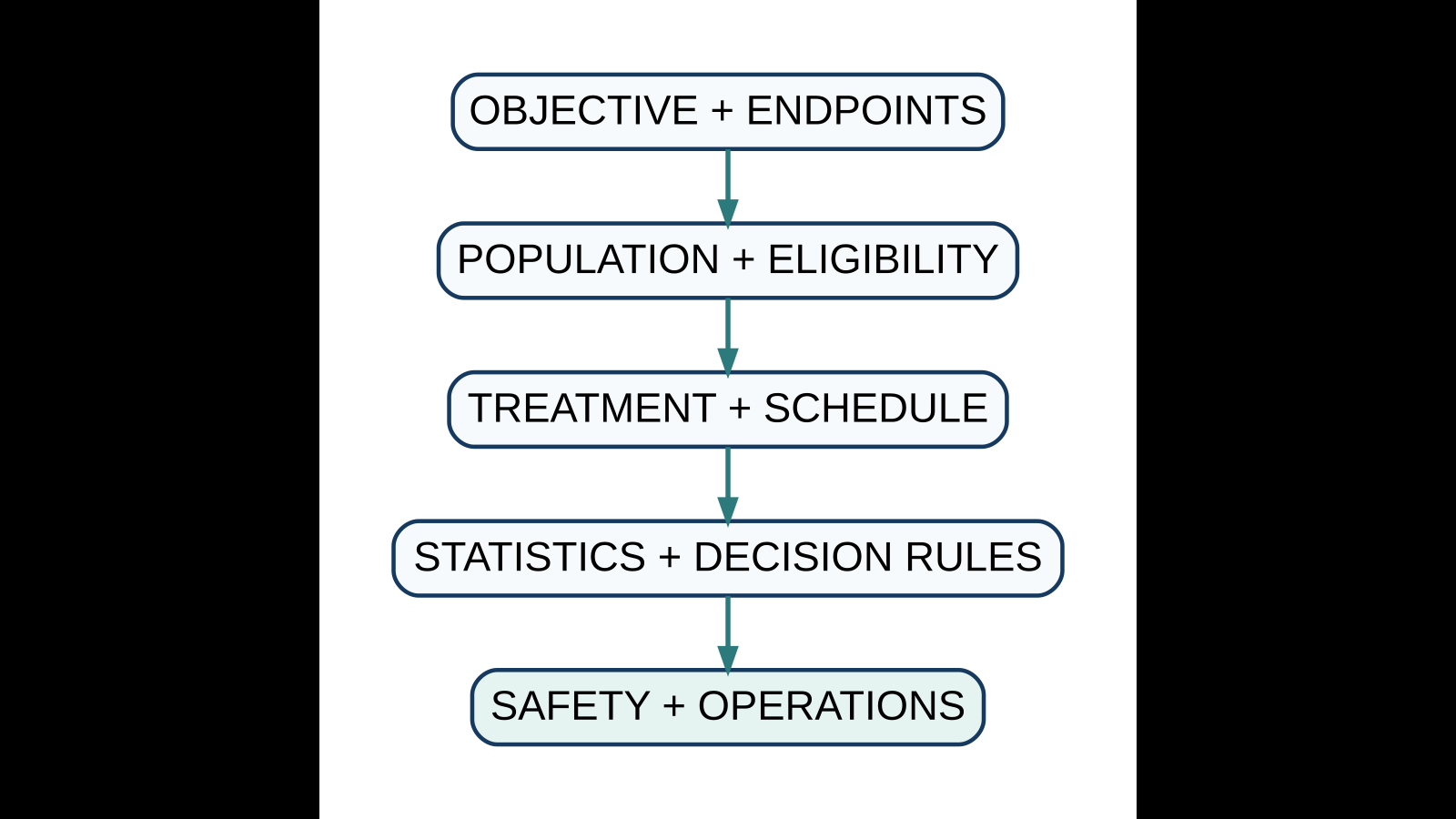
At minimum, lock the study objective and decision question, endpoints and assessment methods, population and eligibility logic, treatment and dose strategy, schedule of activities, statistical framework, safety monitoring and stopping rules, operational feasibility, data collection requirements, and ownership of remaining decisions.
Who this checklist is for
This checklist is for a CMO, Head of Clinical Development, Clinical Operations lead, or biostatistics/regulatory leader turning a concept or synopsis into an executable Phase I or II protocol, especially for first-in-human and other early-phase programs.
1. Study objective and decision logic
| Check | Evidence / decision required | Owner | Red flag |
|---|---|---|---|
| Primary objective | One clear scientific/development objective linked to the next program decision | Clinical Development | Objective describes activity rather than a decision or question |
| Primary endpoint | Endpoint directly supports the objective and can be measured as planned | Clinical + Statistics | Endpoint wording differs across synopsis, SAP concept, and schedule |
| Success/decision rule | Define what result or safety state supports progression | CMO / Program lead | No agreed interpretation of the expected output |
2. Population and eligibility
Define the intended population before writing long inclusion/exclusion lists. Every criterion should have a scientific, safety, endpoint-integrity, or operational reason. Criteria that are copied from another program without a current rationale can narrow recruitment unnecessarily or create inconsistent screening decisions.
- Confirm disease/health status, stage, prior therapy, demographic constraints, and key laboratory thresholds.
- Identify criteria tied to known or potential investigational-product risks.
- Check whether washout, contraception, concomitant medication, and organ-function rules are operationally feasible.
- Confirm that eligibility can be captured cleanly in the eCRF and verified at the site.
3. Treatment, dose, and escalation strategy
For first-in-human or dose-escalation studies, document the starting-dose rationale, dose levels, escalation method, cohort size, sentinel dosing when relevant, dose-limiting toxicity window, review body/decision owner, de-escalation rules, stopping criteria, and how new safety information changes enrollment.
The protocol should not force the site to infer what happens after an ambiguous laboratory result, missed dose, toxicity, or incomplete safety window.
4. Schedule of activities and operational feasibility
Build the visit schedule with Clinical Operations, data management, laboratory, and site reality in mind. The schedule should show which assessments occur when, which windows are acceptable, what is conditional, and how missed or out-of-window procedures are handled.
If data collection requirements are not yet mapped, BioBoston CRO’s eCRF Design and Review support can help identify protocol-to-database gaps before build.
5. Statistical framework
- Define analysis populations conceptually.
- Align endpoints, timepoints, and analysis methods.
- Document sample-size rationale appropriate to the study objective.
- Define escalation, futility, stopping, or expansion rules when used.
- Identify missing-data and intercurrent-event issues that must be resolved in the protocol or SAP.
6. Safety monitoring and escalation
Confirm adverse-event collection, laboratory and ECG monitoring, dose modification, temporary hold, stopping rules, pregnancy management, overdose, special-interest events, and responsibility for reviewing cumulative safety information. The safety architecture should match the known and potential risks described in current product information and the Investigator’s Brochure.
7. Operational ownership
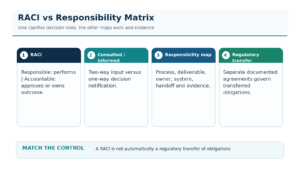
| Decision | Primary owner | Consulted functions | Freeze point |
|---|---|---|---|
| Objectives/endpoints | Clinical Development | Statistics, Regulatory | Before integrated draft |
| Eligibility | Clinical | Safety, Operations | Before site feasibility finalization |
| Schedule | Clinical Operations | Data, vendors, sites | Before database specification |
| Safety rules | CMO/Safety | Clinical, Regulatory | Before final medical review |
8. Common pre-drafting red flags
- The synopsis uses different endpoint language from the statistical concept.
- Eligibility criteria have no documented rationale.
- Visit windows are missing or impossible for sites to meet.
- Dose-escalation decisions depend on data that are not available at the decision time.
- Vendor-dependent assessments have not been feasibility-checked.
- The protocol collects data that no decision or endpoint uses.
- Multiple functions believe they own final wording for the same scientific decision.
Clinical trial protocol checklist: final readiness gate
- Objectives and endpoints align.
- Population and eligibility rationale are documented.
- Treatment and escalation rules are executable.
- Schedule and assessment windows are feasible.
- Statistical and safety decision rules are defined.
- Data collection can be translated into an eCRF.
- Open decisions have owners and deadlines.
Need help turning the design into a controlled protocol?
Explore BioBoston CRO Protocol Writing support for protocol development, cross-functional integration, revision, and quality control. For broader development-sequence decisions, see Regulatory Pathway and Clinical Project Management.