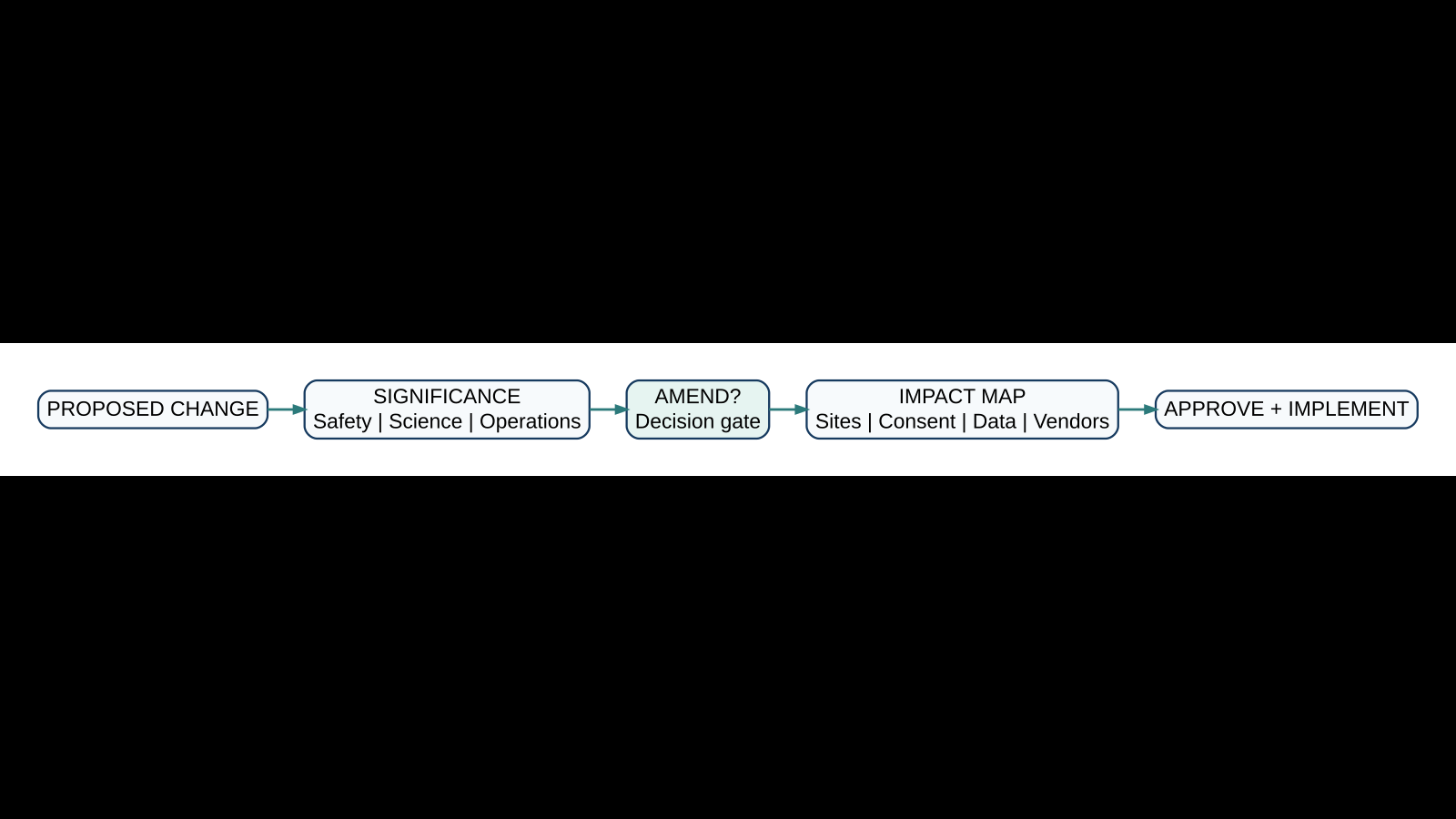
Clinical trial protocol amendment decisions should begin with the significance of the proposed change, not with document formatting. The sponsor needs to determine whether the change alters participant risk, scientific validity, study conduct, eligibility, endpoints, treatment, safety controls, or the information previously reviewed by regulators and ethics committees.
Once an amendment is needed, the harder problem is controlling downstream impact. One protocol change can affect informed consent, eCRFs, randomization, vendor specifications, site training, monitoring, statistical programming, safety documents, and regulatory submissions.
Quick answer: when should a sponsor consider a protocol amendment?
Consider an amendment when a proposed change materially affects participant safety or rights, study objectives/endpoints, eligibility, treatment/dosing, safety monitoring, statistical validity, operational conduct, or information relied on for regulatory/ethics review. Purely administrative changes may not require the same pathway, but they still need controlled assessment.
Who this decision guide is for
This guide is for Clinical Development, Clinical Operations, Regulatory, biostatistics, and medical-writing leaders managing Phase I/II protocols and deciding whether a change warrants formal amendment and how to implement it without creating uncontrolled downstream inconsistencies.
1. Classify the proposed change
| Change class | Examples | Amendment likelihood |
|---|---|---|
| Safety-critical | New risk, stopping rule, monitoring, dose change | High; assess urgently |
| Scientific/design | Objective, endpoint, population, cohort, sample size | High |
| Operational substantive | Visit/assessment changes affecting conduct or burden | Often high |
| Administrative/editorial | Contact, typo, non-substantive clarification | Potentially low; document assessment |
2. Score the change before deciding
Use a simple sponsor-side score to force discussion. This is not a regulatory formula.
| Factor | 0 | 1 | 2 |
|---|---|---|---|
| Participant risk | No effect | Possible minor effect | Material/new risk implication |
| Scientific validity | No effect | Limited effect | Objective/endpoint/analysis impact |
| Study conduct | No effect | Local/process effect | Changes site execution or participant burden |
| Regulatory/ethics basis | No effect | Clarification | Changes reviewed/approved information |
Higher scores should trigger a formal cross-functional amendment assessment, not an automatic conclusion. Regulatory Affairs should apply the jurisdiction-specific requirements.
3. Immediate-hazard branch
If a change is needed to eliminate an immediate hazard to participants, safety takes priority. Document the rationale and actions, then follow applicable requirements for regulator and IRB/IEC notification and any subsequent amendment. Do not force an urgent safety action through the routine change calendar.
4. Build a downstream impact map
- Informed consent and participant materials.
- Investigator’s Brochure and safety-management documents.
- eCRF/database edit checks and data-management plan.
- Randomization/IRT and drug-supply rules.
- Laboratory, imaging, central reader, and other vendor specifications.
- Site training, monitoring tools, and source requirements.
- SAP/statistical programming and endpoint derivations.
- Regulatory/ethics submissions and approvals.
For database impact, involve eCRF Design and Review before implementation so the protocol and data collection stay aligned.
5. Decide implementation sequence
| Gate | Question | Owner |
|---|---|---|
| Scientific approval | Is the revised design accepted internally? | Clinical/CMO |
| Regulatory route | What submissions/notifications are required? | Regulatory |
| Ethics route | What IRB/IEC approval is required? | Regulatory/Site management |
| Operational readiness | Are systems, vendors, training, supplies ready? | Clinical Operations |
| Effective date | When may sites implement the change? | Program governance |
6. Control mixed-version risk
During rollout, some sites may still operate under the prior version while others are ready for the new version. Track site-level approval, training, document availability, system readiness, and effective version. Avoid ambiguous instructions such as “implement when possible.”
7. Red flags
- The amendment changes an endpoint but the SAP and eCRF are not in the impact review.
- Consent implications are assessed after regulatory submission.
- Sites are trained before final approved wording is stable.
- Multiple amendment changes are bundled without a single change log.
- Urgent safety changes wait for routine governance meetings.
- No owner has authority to decide whether late requests enter the amendment.
8. Questions sponsors should ask before approval
- What problem is this change solving?
- What happens if we do not make it?
- Does it affect participant risk or burden?
- Does it change interpretation of the study?
- Which regulators/ethics bodies must review it?
- What dependent documents/systems must change?
- Can all sites implement it consistently?
Recommended next steps
Create one amendment decision record, one downstream impact matrix, and one implementation tracker. Freeze the scientific change before finalizing dependent documents, then use controlled version/effective-date governance across sites and systems.
Need help controlling a protocol amendment?
Explore BioBoston CRO Protocol Writing support. For broader regulatory sequencing use Regulatory Pathway, and for cross-vendor implementation use Clinical Project Management.