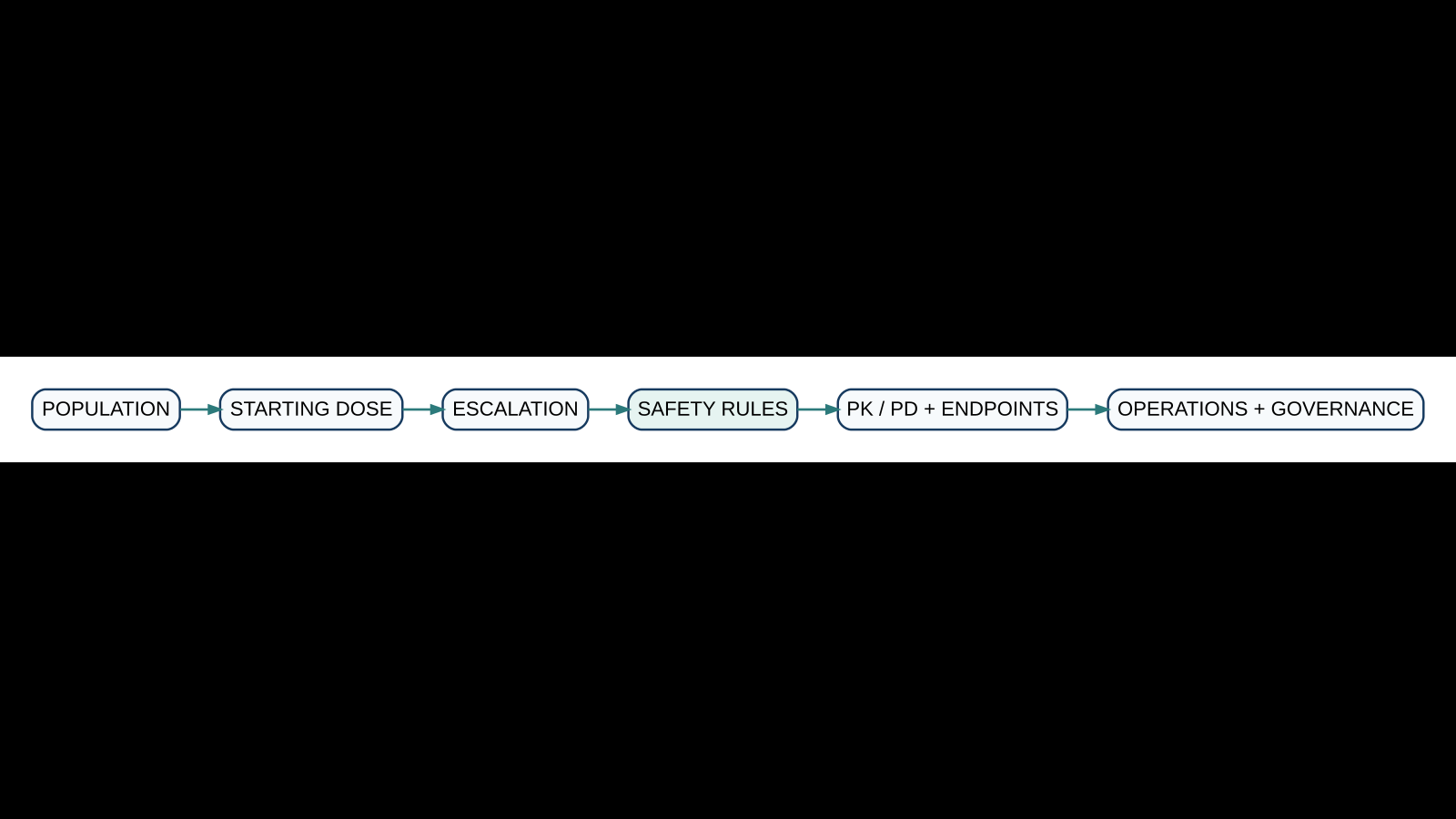
Phase 1 clinical trial protocol design should begin with explicit sponsor decisions, not a blank template. Before authoring accelerates, the team should resolve the questions that determine participant risk, dose progression, data interpretability, and operational execution.
For first-in-human and other early-phase studies, several decisions are tightly linked. The starting dose influences escalation; escalation depends on safety observation and data availability; PK/PD sampling affects visit design; and stopping rules depend on the known and potential risks summarized in the current product information.
Quick answer: what should be resolved before authoring a Phase I protocol?
Resolve the target population, starting-dose rationale, dose-escalation method, cohort and replacement rules, safety observation and stopping criteria, PK/PD strategy, endpoints and decision rules, food/administration controls, operational feasibility, and governance for real-time dose/safety decisions.
Who this guide is for
This guide is for CMOs, Clinical Development, Clinical Operations, biostatistics, and Regulatory leaders preparing first-in-human or early Phase I/II protocols.
1. Who is the right initial population?
Decide healthy volunteers versus patients, disease stage, prior therapies, demographic restrictions, organ-function expectations, and risk-based exclusions. The choice should reflect product mechanism, nonclinical findings, anticipated risks, ethical considerations, and the information needed from the study.
2. What supports the starting dose?
Document the evidence and calculation approach that supports the proposed starting dose. Ensure the protocol language is consistent with the nonclinical/clinical pharmacology rationale and clearly identifies any assumptions or exposure limits used in decision-making.
3. How will dose escalation work?
Define dose levels, cohort size, escalation increments, data required before escalation, who reviews the data, and how incomplete or nonevaluable participants are handled. Avoid generic language that leaves the actual escalation decision to informal meeting practice.
4. What is the DLT or equivalent safety-evaluation window?
If dose-limiting toxicity is used, define the observation window, qualifying events, grading criteria, attribution logic, and exceptions. If a different safety framework is appropriate, make the decision rules equally explicit.
5. What triggers pause, de-escalation, or stopping?
| Trigger type | Protocol question | Decision owner |
|---|---|---|
| Individual participant | When must dosing stop/hold for one participant? | Investigator + Medical Monitor |
| Cohort | What pattern pauses further dosing/escalation? | Safety review body |
| Study-wide | What event or trend stops enrollment/dosing? | Sponsor/committee per protocol |
6. What PK/PD data are required for the next decision?
Specify sampling times, windows, bioanalytical dependencies, and when the data must be available relative to escalation or expansion decisions. A dense PK schedule is not useful if the operational timing prevents the data from informing the decision it was meant to support.
7. What endpoints will actually guide development?
Separate safety/tolerability, PK, PD, biomarker, and exploratory efficacy objectives. Define which endpoints are descriptive and which influence progression. Align endpoint definitions with the schedule and statistical approach.
8. What administration and food controls matter?
Resolve fasting/fed conditions, administration instructions, formulation/device considerations, prohibited foods/medications, timing relative to assessments, and handling of vomiting/missed doses where relevant. Product-specific FDA guidance may change the right approach.
9. Can the protocol be executed at real sites?
- Can sites meet observation and sampling windows?
- Can central labs/vendors return critical data before escalation decisions?
- Can participants tolerate the visit burden?
- Are specialized procedures feasible at selected sites?
- Can the database and IRT support cohort/dose logic?
Use Clinical Project Management to coordinate dependencies, and eCRF Design and Review when protocol-to-data translation is a risk.
10. Who has authority to make dose and safety decisions?
Define the review body, required attendees/data, quorum if relevant, meeting timing, documentation, escalation of disagreement, and authority to pause or resume. Governance should be described clearly enough that a monitor or site can understand the resulting instruction.
Phase I design readiness table
| Decision | Evidence ready? | Owner | Protocol status |
|---|---|---|---|
| Population | Yes/No | Clinical | Locked / open |
| Starting dose | Yes/No | Clinical Pharm/Nonclinical | Locked / open |
| Escalation/stopping | Yes/No | CMO/Safety/Statistics | Locked / open |
| PK/PD schedule | Yes/No | Clinical Pharm | Locked / open |
| Operations | Yes/No | Clinical Operations | Locked / open |
Common early-phase failure points
- The escalation rule depends on data that will not be available in time.
- Safety thresholds conflict with eligibility or dose-modification language.
- PK sampling windows are operationally unrealistic.
- Replacement-participant rules are undefined.
- Governance is described informally outside the protocol.
- Late vendor feasibility forces a protocol amendment.
Action checklist before authoring
- Document the 10 decisions and owners.
- Identify evidence gaps and resolution dates.
- Run site/vendor feasibility on critical procedures.
- Confirm endpoint and statistical alignment.
- Ensure current product risk information is reflected.
- Freeze the decision rules before final integrated drafting.
Need help developing the protocol?
Explore BioBoston CRO Protocol Writing support. For regulatory strategy questions, see Regulatory Pathway.