Labeling change control should begin whenever a product or evidence change could alter what the label, labeling, IFU, package insert, electronic labeling, or related user information says—or should say. The trigger is not limited to a request to “change the label.”
A manufacturing, design, software, formulation, intended-use, safety, performance, packaging, or usability change can create labeling impact even when the original change request originates outside Regulatory Affairs.
Quick answer: when does a product change need labeling regulatory review?
Trigger a labeling review when a change affects intended use/indications, claims, performance, risk, warnings/precautions, instructions, user population, administration/use conditions, product identity/configuration, storage, packaging, UDI, or information relied upon in an authorization or submission.
Who this guide is for
This guide is for Regulatory Affairs and cross-functional product teams managing drug, biologic, medical-device, or diagnostic labeling changes. The decision tree supports initial triage; the final regulatory route must be based on the applicable product-specific requirements.
1. Start with the change trigger
| Trigger | Potential labeling impact |
|---|---|
| New clinical/performance evidence | Claims, warnings, limitations, population, directions |
| Safety signal/complaint trend | Warnings, precautions, contraindications, instructions |
| Design/software change | Workflow, screens, compatibility, instructions, warnings |
| Manufacturing/formulation change | Description, storage, administration, performance, risk |
| Packaging/configuration change | Identifiers, components, UDI, handling, directions |
| Intended-use/indication strategy | Core claim and regulatory basis |
2. Score labeling impact
This sponsor-side score is a prioritization aid, not a regulatory test.
| Factor | 0 | 1 | 2 |
|---|---|---|---|
| Claims/intended use | No impact | Clarification | Material change |
| Safety/risk | No impact | Minor update | New/material risk control |
| User instructions | No impact | Editorial/process clarification | Changes how product is used |
| Regulatory evidence | Same evidence | Updated evidence | New evidence/authorization implication |
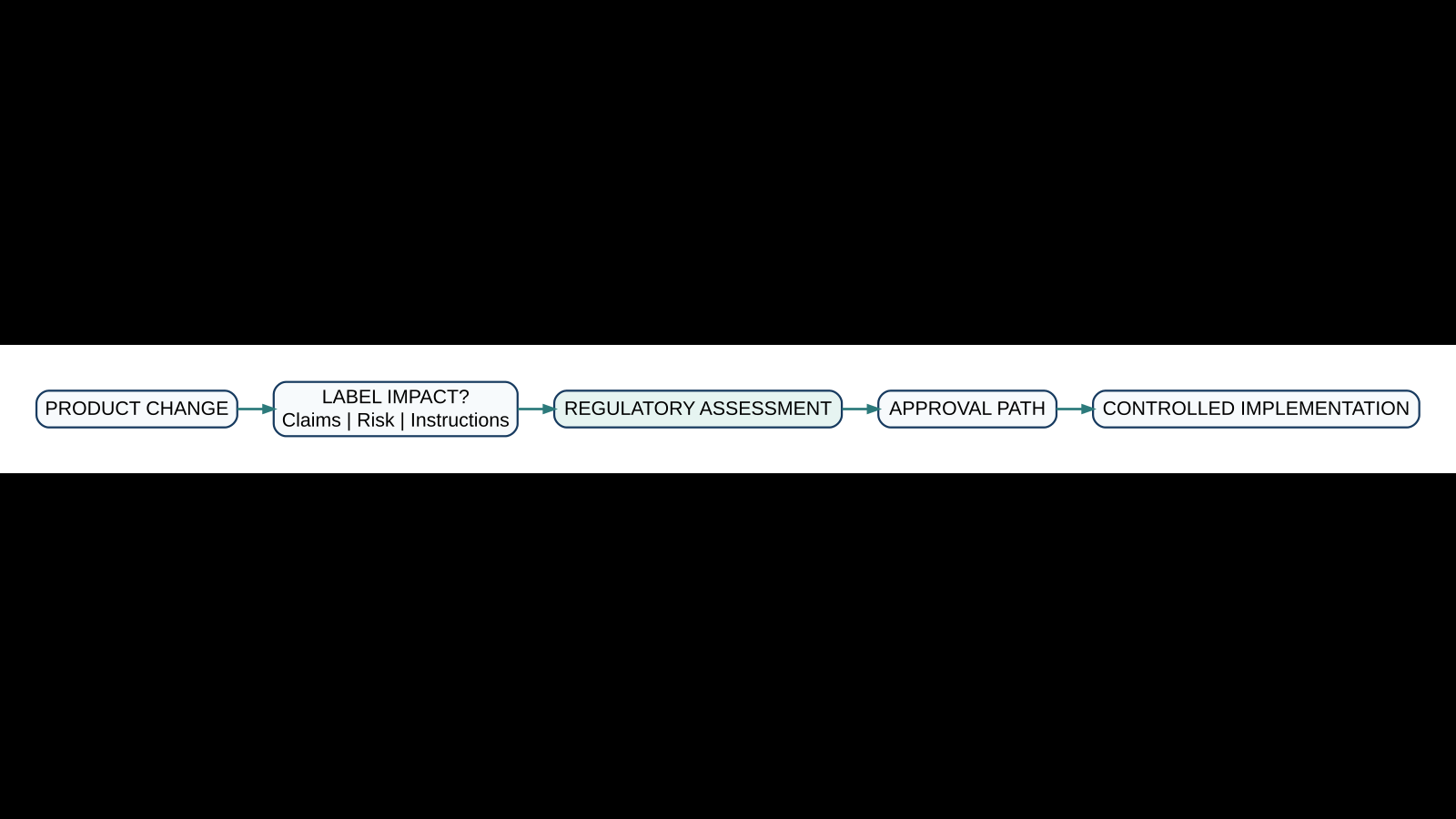
3. Decision tree
- Does the product change affect user-facing information? If no, document the rationale and assess indirect impacts.
- Does it affect claims, risk, instructions, identification, or conditions of use? If yes, route to Regulatory labeling assessment.
- Does the revised labeling remain within the current regulatory basis? Determine product-specific submission/notification/approval requirements.
- Can the change be implemented consistently? Coordinate artwork, inventory, digital labeling, training, systems, and effective date.
4. Build a labeling impact assessment
| Field | Record |
|---|---|
| Change description | What changed and why |
| Affected labeling | Label, IFU, insert, packaging, electronic, training, promotional as applicable |
| Evidence | Risk analysis, study/report, complaint/safety data, validation |
| Regulatory assessment | Applicable product/market route and rationale |
| Approvals | Regulatory, Quality, Medical/Safety, product owner, other required functions |
| Implementation | Effective date, inventory transition, market/site communication |
5. Assess evidence before changing claims
A product change may improve performance, usability, or safety, but the label cannot simply inherit the development team’s preferred interpretation. Trace the proposed wording to the evidence and regulatory basis. Use Safety and Efficacy Summaries when evidence synthesis is needed to support the assessment.
6. Control implementation
Labeling changes can fail after approval if old and new versions are released inconsistently. Define effective date, inventory disposition, market/site rollout, electronic updates, training, customer communication, UDI/data changes where applicable, and how superseded labeling is controlled.
7. Red flags
- Regulatory first sees the change after design/manufacturing approval.
- A new claim is treated as “wording only.”
- Risk controls change without IFU/warning assessment.
- Artwork and electronic labeling use different effective dates.
- Old inventory continues without a documented transition decision.
- The submission/notification route is assumed from a different product type.
Questions to ask before approval
- What user-facing meaning changed?
- What evidence supports the new wording?
- Does the change affect risk or benefit-risk communication?
- Does it remain within the current regulatory position?
- Which markets/products/configurations are affected?
- What implementation dependencies must be synchronized?
Recommended next steps
Use one controlled change record linking the originating product change, labeling impact, evidence, regulatory assessment, approvals, and implementation. Escalate uncertain pathway questions through Regulatory Pathway before release.
Need help with labeling change control?
Explore BioBoston CRO Labeling Support for labeling impact assessment, evidence alignment, cross-functional review, and controlled implementation.