Clinical trial budget and timeline forecasts become decision-ready when each significant cost assumption is connected to an activity, milestone, unit, date, vendor and source of evidence. A monthly financial total that ignores site activation, enrollment, protocol changes and database milestones cannot tell a sponsor what delay or acceleration will cost. Build one integrated baseline and update forecast dates and the cost-to-complete together.
This framework serves Clinical Operations, Finance, Procurement and Program Management leaders overseeing outsourced early-phase studies. It provides a linked cost-and-schedule register, a variance bridge, a simple scenario method and a worked hypothetical example. It is a recommended management method, not a regulatory financial reporting standard. The study’s approved contracts, accounting policies, currency treatment and approval limits govern actual financial decisions.
Assemble a baseline that can be audited
Begin with the current approved protocol, schedule of assessments, site and country plan, vendor scopes, contracts, statements of work, units, rates, pass-through assumptions, milestone payment conditions, contingencies and committed purchase orders. Make the baseline date explicit. Keep the original approved budget separate from the latest estimate and the cash forecast; those answer different questions.
Use a shared coding dictionary. If the CRO bills site startup within project management while the lab bills screening kits by participant, map both to the study workstream they enable, but retain the contractual invoice categories. Otherwise a team can confuse coding differences with genuine variance. Mark exclusions and unpriced dependencies rather than treating missing cost as zero.
For every milestone distinguish the planned date, current evidence-based forecast date, actual completion date, and approval/acceptance date. An invoice milestone may trigger on a contractual event different from operational completion. Finance should not use a clinical slide as proof that a contractual payment is due, and Operations should not infer an activity is complete because an invoice arrived.
The copyable integrated milestone and cost register
Use one row per relevant vendor deliverable, recurring activity or material dependency. The simplified table below is a starting point; add site/country, currency, funding source, protocol version and approval reference as needed.
| Milestone or workstream | Operational evidence and owner | Cost behavior and source | Forecast trigger / sponsor decision |
|---|---|---|---|
| Protocol and approvals | Approved protocol, regulatory/ethics status; Regulatory | Fixed writing, submission or amendment fees; approved SOW | Amendment or review-cycle change; approve revised scope |
| Site activation | Site readiness and essential-record acceptance; Clinical Ops | Per-site activation fees plus startup support | Sites delayed or added; approve footprint and revised dates |
| Enrollment and visits | Screen, consent and visit forecast; Clinical/Medical | Per-participant and visit units; monitoring effort | Changed conversion, visits or population; revise units |
| Investigational product and supply | Release, depot, distribution and resupply evidence; Supply | Batches, kits, shipping, storage and expiry | Material lead time or shelf-life issue; decide supply scenario |
| Data and laboratory transfers | Accepted transfer, reconciliations and EDC status; DM | Data-management effort, lab unit rates and system fees | New mapping or delayed feeds; revise effort and lock date |
| Database lock and analysis | Reconciliation, quality checks and final data freeze; DM/Biostats | Ongoing data cleaning, statistical and reporting work | Lock shifts; recalculate retained team months |
| Closeout and archive | TMF, site closure, data/records handoff; QA/Clinical | Closeout fees, storage and extended operations | New end date; confirm records and exit costs |
Field-by-field rules: the owner is the person accountable for the source evidence, not necessarily the commercial approver. Cost behavior must specify whether the contract is time-and-materials, fixed milestone, per-unit, retainer or pass-through. The forecast trigger describes the event that changes cost, not just a red status. Every material change needs a named sponsor approval path.
Use three linked forecasts, never one opaque number
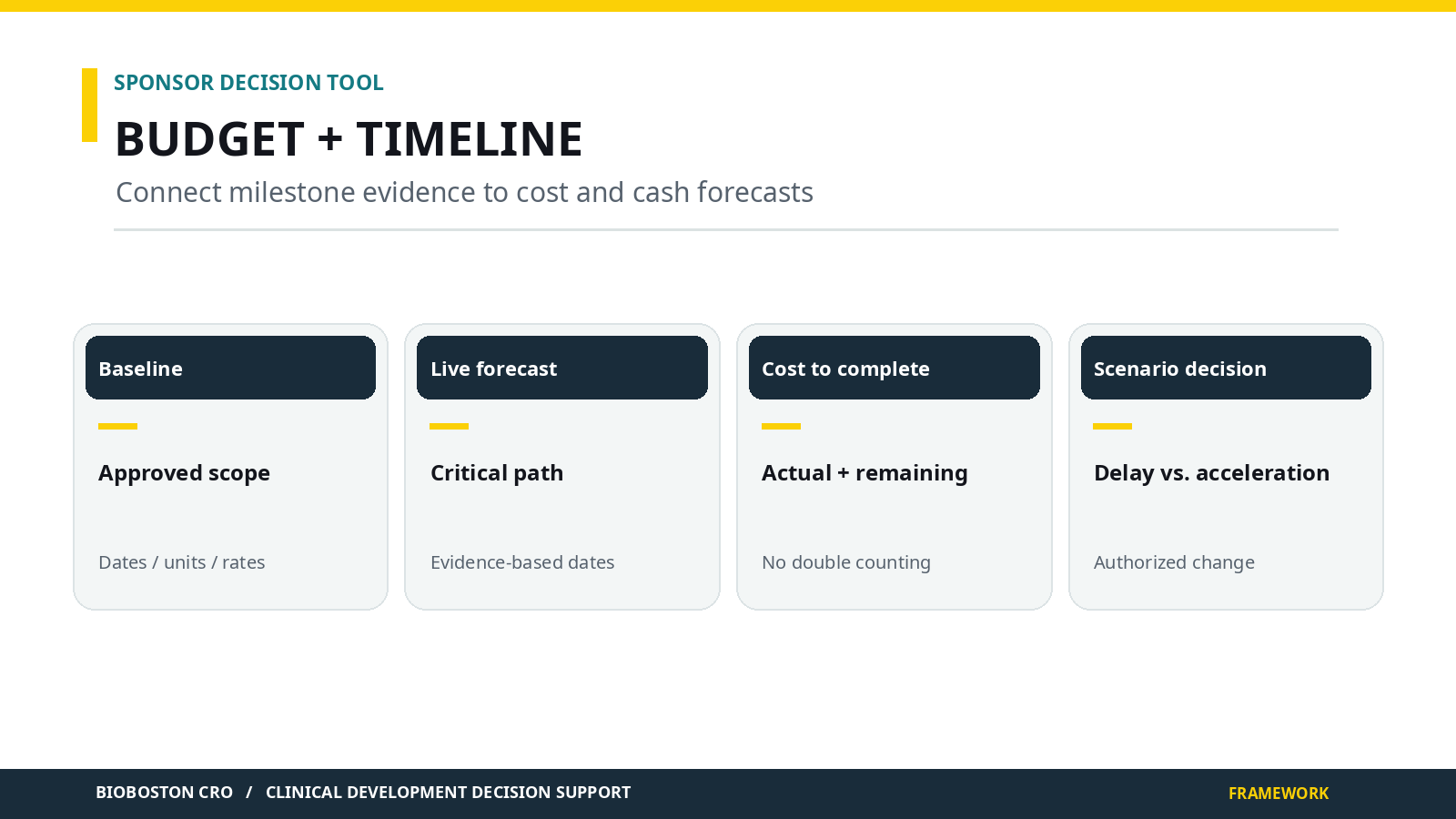
Operational forecast: When will the accepted deliverable or milestone actually be achieved, under what constraints, and with what confidence? Keep dependencies and alternative scenarios visible. Cost estimate at completion (EAC): Actual cost to date plus a justified estimate to complete the remaining work. Cash forecast: When invoices and payments are expected under payment terms. These three views will differ; force-reconciling them into one spreadsheet cell is an error.
A simple EAC equation is EAC = validated actual cost incurred + estimated remaining cost. The remaining cost can include authorized work not yet invoiced, expected variable units, extended vendor duration and foreseeable rework. To avoid double counting, reconcile outstanding commitments and accruals against what is already included in actual costs. An unpaid invoice may be a cost already incurred but not a future additional scope expense. A purchase order is a commitment, not necessarily incurred cost.
To show the change, build a variance bridge from approved baseline to current EAC: volume, rate, duration, country/site footprint, scope change, pass-through, foreign exchange, true estimate error and controlled contingency. Each bridge item has evidence, decision authority and whether it is approved, probable or merely a scenario. Duration extensions often affect project management, monitoring availability, systems licenses, vendors on retainer and sites, but the actual impact depends on contract terms.
Hypothetical forecast: timeline delay is not a single surcharge
Illustrative example; not a BioBoston estimate: A sponsor approved a $2.0 million study baseline. Validated incurred cost is $0.8 million. The remaining approved scope is forecast at $1.2 million if milestones stay on time. Site readiness changes the first-patient forecast by two months. The project team estimates $60,000 of additional vendor management and systems duration, $25,000 of revised startup tasks and $15,000 of contingency draw for identified exposure. A proposed acceleration could reduce delay but add $45,000 in expedited site preparation.
| Scenario | EAC calculation | Estimated total | Decision question |
|---|---|---|---|
| Approved baseline | $0.8m incurred + $1.2m remaining | $2.000m | Is the old schedule still credible? |
| Delay without acceleration | $2.0m + $0.060m + $0.025m + $0.015m | $2.100m | Accept later milestone and extra duration cost? |
| Accelerate selected readiness tasks | $2.0m + $0.060m + $0.025m + $0.015m + $0.045m minus any verified avoided cost | Up to $2.145m before savings | Does the time saved justify premium cost and risk? |
The example deliberately does not promise that paying for acceleration saves two months. Validate feasibility, resource availability, quality, vendor terms and critical-path impact first. If an acceleration prevents documented extension charges, include only those defensible offsets. Separate cash impact from EAC: some acceleration invoices may be due earlier even if ultimate cost barely changes.
Decide how to handle risk, uncertainty and change orders
Unapproved scope belongs in an exposure register and scenario, not silently in an approved baseline. For a vendor change order, record trigger, original assumption, impacted deliverable, unit/rate evidence, alternative approaches, schedule consequences, quality/regulatory implications, negotiated amount, cost-to-complete change and sponsor authorization. If the issue is actually vendor nonperformance under existing scope, first test contractual obligations rather than accepting a new fee without analysis.
Use three forecast states: approved (formal baseline), current expected (management estimate with assumptions), and decision pending (range of alternatives). A board may need all three, especially if runway is limited. Provide low/base/high scenarios when uncertainties are material, but do not assign arbitrary probabilities to medically or operationally complex risks without evidence.
Reconciliation should be monthly for a stable study and more frequent around critical changes if justified by risk; this is a recommended cadence, not a universal requirement. Clinical Operations owns milestones, Finance owns accounting and cash, Procurement/Legal owns contract interpretation, QA/Regulatory advises on relevant control impacts, and the authorized sponsor leader approves rebaselining and commercial choices.
The meeting packet that executives can actually use
Put the current critical-path milestone, EAC movement, cash-flow variance, key assumptions, unapproved exposure and decisions required on one page. Attach the line-item register and evidence references as supporting detail. Ask whether the sponsor is funding more activity, buying back time, adjusting scope or accepting a new program risk. Do not present a variance without a decision consequence.
A useful six-field change decision records: (1) event and evidence; (2) affected workstream and predecessor; (3) timing change, including confidence; (4) EAC and cash impact; (5) alternatives and risks; and (6) named authorization and next check. Include the date and version of the protocol, contracts and schedule used. If a source conflicts, label it disputed and name the reconciler.
Failure modes and sponsor corrections
An overly optimistic enrollment curve can hide per-visit cost changes. A late lab transfer can extend database work despite a green enrollment signal. Cash paid to date can falsely suggest cost under control when accruals, open commitments or unresolved changes are missing. Vendor budgets can appear within cap because work is deferred, not eliminated. A dated milestone can hide a conditional dependency on product release or country approval.
Correct these by linking an accepted operational event to each material forecast assumption and by testing whether a proposed decision changes the real critical path. A schedule recovery that moves a reporting date without releasing its predecessors is not a recovery. A lower forecast that omits necessary quality work is not a saving.
Regulatory and service boundaries
This is an operational and financial planning framework. The relevant cost obligations arise from the study’s contracts, plans, policies and approved scope; there is no FDA-specified standard format for the matrix above. FDA’s ICH E6(R3) Good Clinical Practice guidance encourages risk-proportionate quality oversight but does not prescribe a particular study budget spreadsheet. Participant protection, data reliability and applicable regulatory controls should be considered when choosing cost or schedule alternatives; cost pressure does not override them.
BioBoston CRO Budget Tracking support can help reconcile baselines, vendor proposals, actuals, accruals, forecast scenarios and decision packages. Related Study Timeline Management support can connect the financial model to true dependencies and milestone confidence.
Need one reconciled decision view of timeline and study cost? Explore BioBoston CRO Budget Tracking.