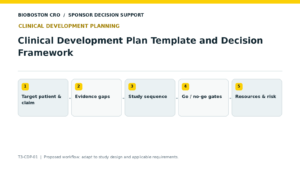
An emerging biotech clinical operating model should be designed around the decisions the sponsor must make, the work required to support those decisions and the evidence needed to know whether outsourced execution is under control. The best team is not necessarily the largest internal team or the cheapest full-service contract. A lean sponsor needs clear decision rights, competent medical and quality review, integrated study delivery, realistic capacity and defined interfaces with specialized providers.
This resource is for a VP or Head of Clinical Operations, Clinical Program Director, COO or CMO building an early-phase clinical program. It includes a sourcing decision matrix, three illustrative delivery models, a sponsor operating charter and the questions to answer before hiring or outsourcing another role. The proposed role allocation is a recommended planning framework, not a universal staffing requirement or a claim about BioBoston CRO’s past client programs.
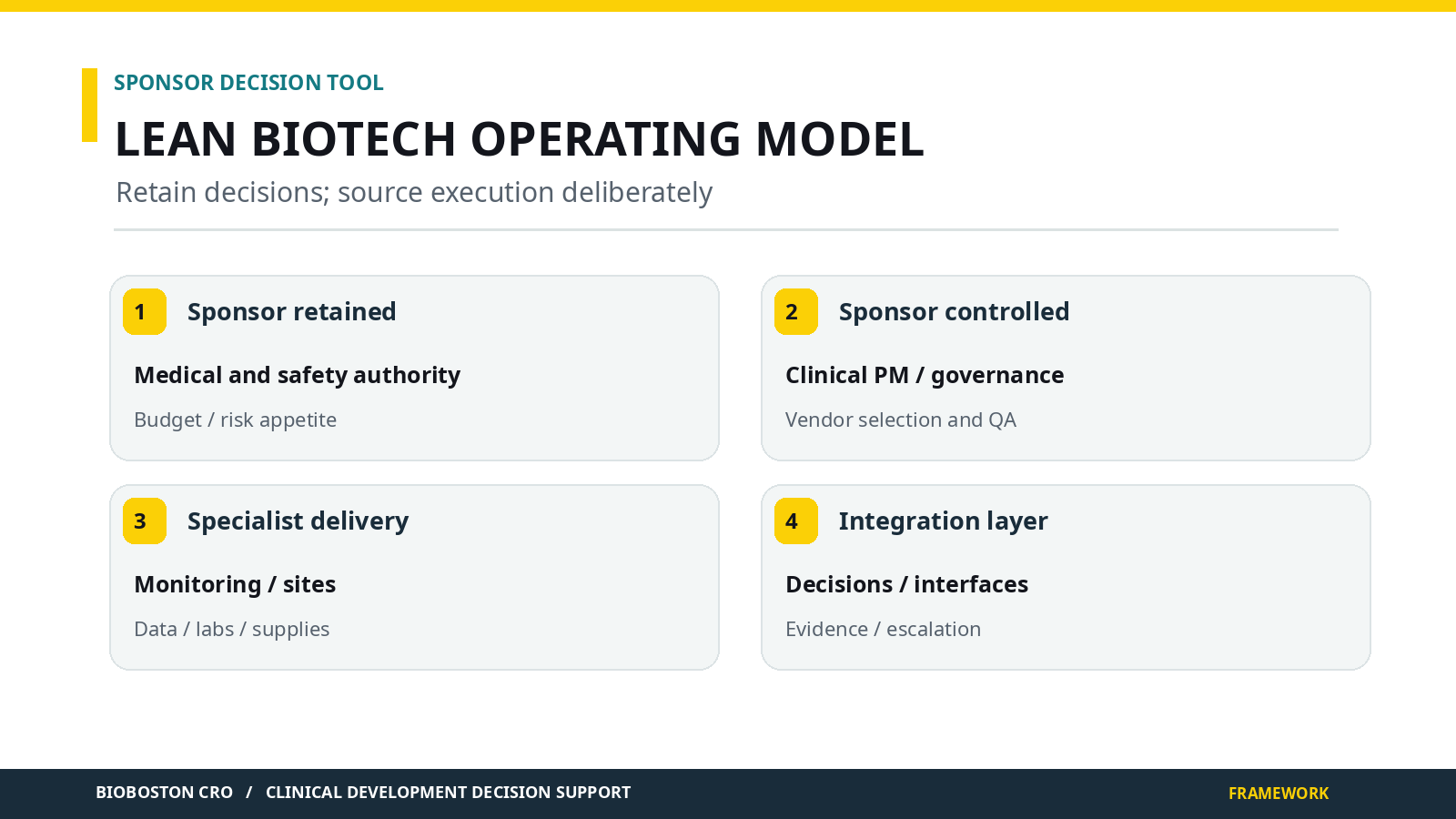
Separate authority, accountability, oversight and execution
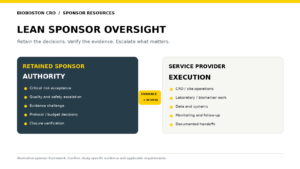
Use four words consistently. Authority is the right to approve a protocol decision, spending commitment, risk acceptance or program change. Accountability is answerability for ensuring a defined result and controlling the interface. Oversight is risk-proportionate verification of critical work, evidence and follow-up. Execution is the qualified performance of tasks such as monitoring, data handling or sample logistics. One person may perform several functions, but the model should identify when independence or additional review is needed.
For US investigational drug studies, 21 CFR 312.50 addresses general sponsor responsibilities. 21 CFR 312.52 permits specified sponsor obligations to be transferred to a CRO in writing; obligations not described as transferred are deemed not transferred. The precise legal and operational allocation requires study-specific review. FDA’s September 2025 ICH E6(R3) GCP guidance offers nonbinding, risk-proportionate recommendations on quality by design, sponsor oversight and service providers. The organizational chart in this article is not itself proof of regulatory compliance.
The operating model must also distinguish corporate roles from study roles. A Chief Medical Officer may approve scientific strategy while a contracted qualified medical monitor handles time-sensitive medical review under a defined agreement. A fractional QA leader can design independent checks, but an unresolved serious quality issue still needs a designated sponsor decision route. A CRO project manager can organize vendor activity without controlling the sponsor’s financial authorization. Avoid assigning obligations by title alone.
The practical keep-versus-outsource decision test
Assess each function using five criteria before deciding who will perform it: decision criticality, frequency of hands-on work, availability of suitable internal expertise, independence or assurance need, and handoff complexity. Retain the authority needed for high-consequence sponsor decisions. Assign specialist execution where qualified capacity and systems can be accessed without compromising continuity. For a function with many cross-vendor handoffs, consider retaining or embedding a dedicated integration role even when execution is outsourced.
Do not use a simple cost-per-hour comparison as the decision rule. An apparently inexpensive outsourced role may require significant internal coordination and rework. An internal hire may need time to recruit and may be underutilized outside peak development periods. Evaluate the total model, including supervision, qualified backup coverage, licenses, data and record access, transition exposure, lead times and the cost of delayed decisions.
Copyable clinical operating model allocation matrix
The table separates the likely sponsor decision interface from the specialists who may execute work. Adapt each row to the trial’s product, risk and regulatory context. ‘Can outsource’ does not mean every BioBoston CRO service is performed in house; some site-, patient-, medical-monitoring-, supply- or monitoring-related execution may be provided through qualified partners under clear contractual arrangements.
| Clinical program function | Sponsor-retained or sponsor-controlled decision | Execution that may be contracted | Evidence and escalation interface |
|---|---|---|---|
| Development strategy and protocol | CMO/medical authority accepts design, objectives and key risk | Medical writing, feasibility and specialist input | Controlled protocol decisions, medical review, change-impact approval |
| Clinical operations and project integration | Sponsor Study Lead approves plan, priorities, cross-functional decisions | Embedded project management, CRO study delivery, site startup | Integrated schedule, risk/issue log, named decision owners |
| Participant safety and medical oversight | Qualified medical/safety decision authority and reporting pathway | Medical monitoring, safety case processing and specialist services | Safety reconciliation, medical coverage, escalation and backup records |
| Regulatory affairs | Sponsor Regulatory Lead decides strategy and submission position | Submission authoring, formatting and country support | Approval register, correspondence and change-control evidence |
| Quality management and assurance | Sponsor Quality authority accepts risk-based quality approach, audit response and critical CAPA disposition | GCP audits, TMF quality support, validation specialists | Audit/deviation/CAPA source records and effectiveness evidence |
| Site monitoring and startup | Sponsor Clinical Ops sets critical oversight and go/no-go gates | Site selection support, monitoring and activation services | Site readiness, monitoring findings, critical issue tracking |
| Data management and EDC | Sponsor Data/Medical review critical data requirements and readiness | EDC build, data cleaning, lab interfaces and systems support | Data-flow acceptance, query and reconciliation status, access controls |
| Statistics and reporting | Sponsor Biostats/Medical approves key analysis decisions | Statistical programming, analyses and clinical report production | SAP review, analysis readiness, version and quality-control records |
| IMP supply and laboratory operations | Sponsor Supply/Clinical accepts critical availability and operational risk | Manufacture/depot distribution, shipping, central lab services | Release, accountability, resupply and chain-of-custody evidence |
| Vendor, budget and procurement control | Sponsor budget authority approves financial changes and material providers | Vendor-management support, budget analysis and procurement services | SOWs, commitments, forecast, changes, performance and exit plans |
Field-by-field instructions: for each row, name the person authorized to decide, the delivery lead, a qualified deputy, the contract or written responsibility reference, the authoritative record and the escalation time appropriate to the work. Identify any important subcontractor. Do not assume that a RACI letter, a contract signature and a regulatory transfer have the same meaning; reconcile them with Legal, Regulatory and Quality as applicable.
Three viable sourcing patterns for early-phase sponsors
Model A: Sponsor-led core, specialist delivery. A sponsor has a senior Clinical Operations lead, appropriate medical leadership and accessible QA, Regulatory, Finance and data expertise. It outsources site activity, monitoring, systems and specialist execution. Strength: direct sponsor control over critical integration decisions. Constraint: internal leadership must have genuine capacity to manage vendors, not just receive reports. This model can fit a program with a small vendor footprint and a predictable pipeline if internal leads have adequate experience.
Model B: Embedded clinical integrator, sponsor decision board. The sponsor retains CMO/strategy, authorized quality and finance decisions but appoints a dedicated contracted or fractional study program manager to coordinate the CRO, labs, data and other providers. Strength: faster integration of milestones, issues and decision packages without building every function internally. Constraint: the embedded lead needs explicit access to records, a decision escalation route, and authority limits; otherwise the role becomes a messenger rather than an integrator.
Model C: Functional multi-vendor model. Different qualified providers perform monitoring, data, laboratory, clinical supply, medical writing and other services, with the sponsor owning the integration architecture. Strength: modular access to specialized capability and the ability to replace a specific provider without automatically replacing the whole study team. Constraint: a dense network of interfaces creates real obligations for joint testing, evidence acceptance, shared timelines and cross-vendor escalation. This is unsuitable if nobody is accountable for the end-to-end critical path.
None is inherently superior. A full-service CRO can still rely on subcontractors, and an FSP or modular model can still achieve strong quality if the sponsor has the right control points. Choose based on risk, study complexity, capacity, geography, staff continuity, data ownership and contracting model, not simply headcount or label.
Design the sponsor decision calendar before assigning roles
Create a decision cadence from the moments when the trial can change direction. At startup, review protocol approval, site readiness, safety interfaces, systems release and first-patient gates. During conduct, review critical deviations, recruitment confidence, emerging safety information, data quality, vendor performance, supply, change orders and revised cost-to-complete. Before analysis, review reconciliation, data quality, statistical readiness and database lock decisions. The cadence must reflect clinical risk: an urgent safety issue goes straight to its qualified owner, not into the next steering meeting.
Define what each forum decides. An operational delivery meeting may assign tasks and validate facts. A cross-functional sponsor review may decide how to resolve a dependency or accept a forecast. An executive governance group may authorize major spending, scope, a trial pause or vendor replacement. Record the actual decision, owner, rationale, input evidence and effective date. Do not allow a vendor’s green status to become a sponsor’s implicit acceptance of a material risk.
A twelve-field sponsor operating charter
Keep this charter to two or three pages and link it to detailed controlled plans and agreements. Use the following entries as a working template:
| Field | What the sponsor should document |
|---|---|
| 1. Study purpose | Development objective, population, phase, endpoint and critical-to-quality factors |
| 2. Internal capability map | Named medical, clinical, QA, regulatory, data and finance leads, including fractional availability |
| 3. Sourcing boundaries | What is performed internally, by BioBoston/other specialists or through partner-supported providers as applicable |
| 4. Decision authority | Who accepts protocols, safety/quality escalation, scope, contracts, risk and spending |
| 5. Responsibility documents | Contracts, SOW, written obligation allocation where applicable, RACI and quality agreements |
| 6. Critical vendor map | Delivery leads, subcontractors, backup contacts, access and continuity obligations |
| 7. Integrated baseline | Milestones, dependencies, evidence requirements, cost and approved assumptions |
| 8. Risk and quality governance | Risk assessment, critical-to-quality factors, assurance and escalation routes |
| 9. Data and record ownership | System of record, access, export, audit trails, TMF and handoff acceptance |
| 10. Governance forums | Purpose, attendees, decisions, authority limits and reporting cutoffs |
| 11. Capacity and continuity | Peak-demand staffing, deputies, turnover and vendor transition plans |
| 12. Trigger for re-design | Amendment, site/country growth, safety change, vendor performance, funding or phase transition |
The charter is only useful when it is reflected in real contracts, operating procedures and routine decisions. Conduct an interface walkthrough after major staffing or vendor changes: follow a safety case, a lab result, a site readiness exception and a budget change from origin to sponsor decision. Any handoff that requires people to guess the owner needs repair.
Hypothetical application: a four-person sponsor team
Illustrative planning scenario: An emerging biotech has a CEO/COO, CMO, Clinical Operations Director and Regulatory lead. It is preparing a first Phase II study. Those four positions do not necessarily provide enough QA, data, statistics, safety, supply or finance review capacity. The company maps each critical decision and assigns qualified fractional or external support where needed. An embedded senior study lead integrates the vendor delivery plan but escalates clinical protocol, participant safety, quality disposition and budget changes to named sponsor decision authorities.
The team compares a single CRO proposal with a modular laboratory/data/monitoring model. It asks which model can produce accepted site, data and supply evidence on the real critical path; who verifies subcontracted work; and how access and essential records would be transferred if the relationship changes. It does not assume that adding one internal full-time role eliminates the need for specialized assurance. Its decision is documented against capability gaps and an updated financial forecast. This is a hypothetical model, not a client outcome or staffing recommendation for every study.
Signals that the operating model needs redesign
The same individual is approving a risky change and independently certifying it without a suitable review. A contractual interface has no operational owner. Safety contacts and backups cannot be reached. Two vendors present different enrollment baselines. Critical data or TMF access resides solely with a provider. The sponsor cannot produce a documented rationale for a major scope or risk decision. A senior clinical lead spends all available time reconciling spreadsheets instead of directing the program. These are signs to revisit ownership and integration capacity rather than automatically buying another full-service package.
Review the model at each material phase transition and after protocol amendments, geographic expansion, new modalities, major vendor changes, significant findings or funding decisions. Track the outcome of decision readiness, not just whether a committee met. If the sponsor can identify a critical issue, access its evidence, decide promptly and verify the result, the model is doing useful work.
Regulatory and service boundaries
The allocation matrix and charter are BioBoston CRO recommendations. Applicable responsibilities depend on study type, jurisdiction, written contracts and any transfers of IND sponsor obligations. FDA’s final ICH E6(R3) GCP guidance is nonbinding; it supports risk-based study oversight but does not prescribe an organizational headcount. Do not treat outsourcing as a substitute for qualified sponsor decisions, effective interfaces or legal/regulatory review.
BioBoston CRO’s Clinical Project Management services can help build a defined study integration model, ownership map and decision cadence. For practical assurance checks after delegating activities, see Sponsor Oversight services and the related sponsor oversight operating model.
Need an operating model that matches your internal team and outsourced work? Explore BioBoston CRO Clinical Project Management.