Risk based monitoring models are choices about where oversight effort produces the greatest protection for participants and the greatest confidence in critical trial data. On-site, remote and centralized activities each detect some problems better than others. A proportionate monitoring strategy combines them according to the protocol, trial risks, available data and site capabilities; it should not be reduced to a generic percentage of source-data verification.
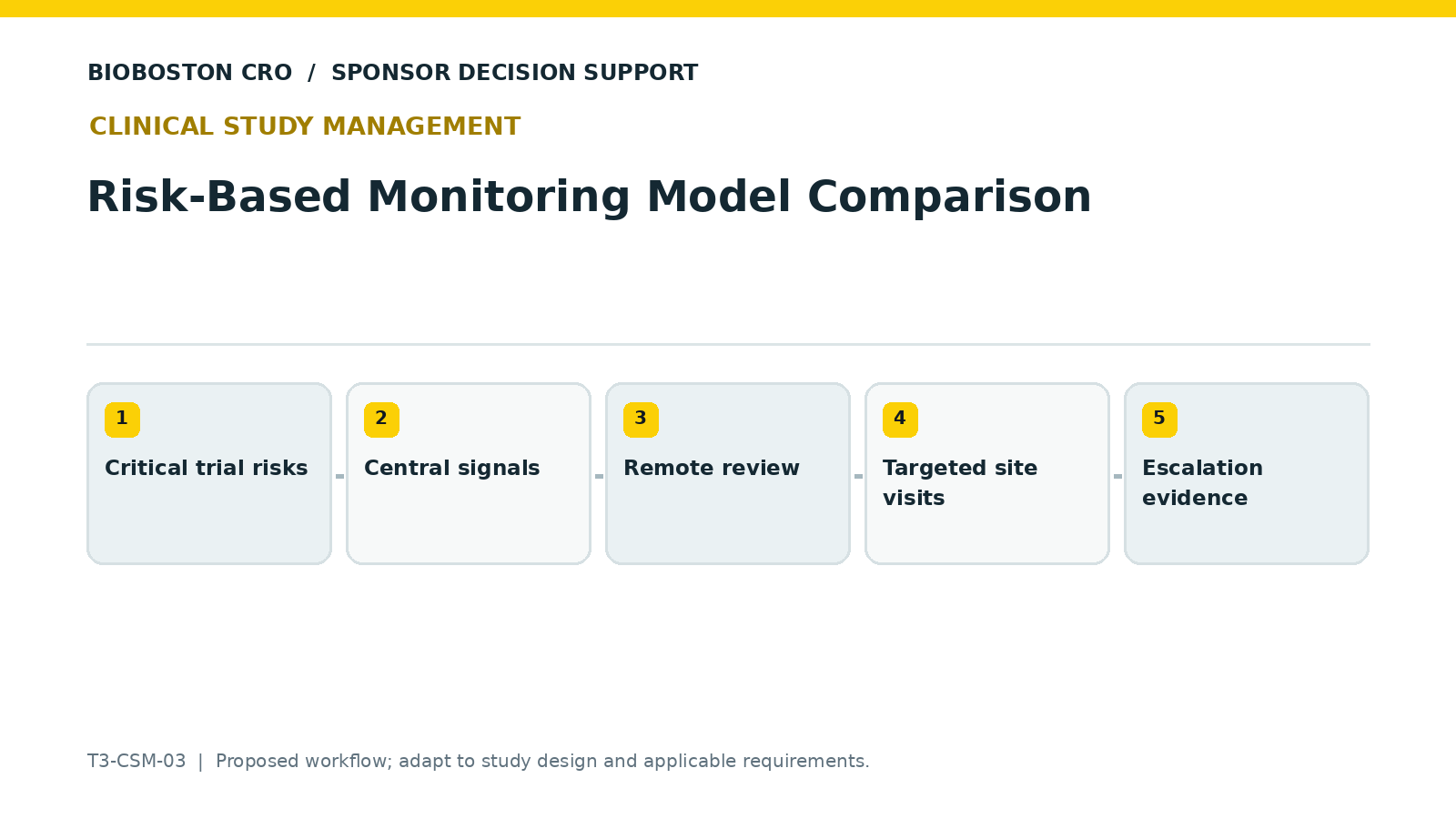
This comparison helps Clinical Operations, Quality and Medical sponsors challenge proposed CRO monitoring plans and adjust them when risk signals change. It is aligned with current FDA risk-based monitoring guidance and ICH E6(R3), while recognizing that each protocol and regulatory context requires its own assessment.
What the sponsor needs to decide
List critical-to-quality factors first: consent, eligibility, study intervention, safety reporting, key endpoints and data reliability. For each factor decide what can be detected centrally, what needs remote records or interviews, and what requires on-site verification. Document response thresholds and escalation ownership.
Risk-Based Monitoring Model Comparison: evidence and decision matrix
| Review point | Evidence to collect | Sponsor decision or acceptance criterion |
|---|---|---|
| On-site monitoring | Source records, consent processes, physical investigational product controls and staff practices | Strong for selected contextual checks; resource-intensive and dependent on visit frequency. |
| Remote monitoring | Permitted remote review, document checks, data queries and staff discussions | Useful when lawful, secure access exists; constrained by local privacy and source access. |
| Centralized monitoring | Cross-site trends, missingness, data outliers, timeliness and risk indicators | Scalable for trends; cannot fully observe unrecorded site behaviors. |
| Targeted source verification | Critical endpoints, eligibility and safety data with documented risk selection | Appropriate when the selection logic is defensible; a blanket percentage may be misleading. |
| Triggered visits and follow-up | Threshold breaches, unusual patterns, training deficits and serious issues | Allocate effort to emerging risk; document triggers, actions and resolution. |
| Hybrid monitoring program | Fit-for-purpose blend of central, remote and on-site oversight | Specify responsibilities, access limits, escalation and change-control rules. |
How to apply this framework to a real sponsor decision
Map risks to detectable signals
Ask for each risk whether it leaves a reliable footprint in data. Missing visits or implausible values may be detected centrally; unreported consent deviations require other evidence. A monitoring plan should show both the potential signal and its blind spots.
Set critical-to-quality priorities
Focus first on participant protection and variables necessary to interpret the primary clinical question. Agree how noncritical records receive proportionate oversight, not zero oversight.
Define triggers and thresholds
A KRI with no owner or action is only a dashboard number. Record the threshold, required investigation, possible site contact or visit, follow-up evidence and decision authority. Distinguish normal study variability from meaningful recurring patterns.
Preserve sponsor oversight of vendors
The CRO can conduct monitoring, but the sponsor needs access to meaningful monitoring outputs, trends, escalations and evidence that actions were effective. Governance records should show risk-based changes to the plan.
Reassess after operational changes
Protocol amendments, new regions, recruitment shifts and recurring deviations may change what monitoring approach is appropriate. Revise the monitoring plan with controlled rationale rather than quietly increasing random visits.
Warning signs that need intervention
- Central data checks are treated as a substitute for every site-practice review.
- Remote monitoring is planned without confirming lawful and reliable source access.
- KRI thresholds exist but no one owns investigation and closure.
- A contract defines visit counts without connecting them to quality risk.
- Monitoring findings are recorded without analyzing repeat or cross-site patterns.
First-week sponsor action plan
- Document critical-to-quality factors and their plausible failures.
- Map each risk to central, remote and on-site detection capabilities.
- Agree KRI triggers, investigation owners and evidence for closure.
- Approve and periodically re-evaluate the monitoring plan with the CRO.
To connect this decision framework to actual study responsibilities, see BioBoston CRO Clinical Study Management support. The service team can help structure sponsor oversight and the evidence needed to make a documented decision; site-facing or other specialized execution may be coordinated with qualified partners where appropriate.
Frequently asked sponsor questions
Does risk-based monitoring eliminate on-site visits?
No. It can change the role and frequency of visits, but on-site review may remain essential for selected risks and contexts.
Is 100% source-data verification required?
No universal fixed percentage follows from the risk-based guidance. The appropriate approach depends on trial risks, critical data and sponsor justification.
Can monitoring be entirely remote?
Only if the strategy adequately controls risks and applicable access, privacy, investigator-site and regulatory requirements are met.
Technical and regulatory context
The framework draws on ICH E6(R3), FDA risk-based monitoring guidance (2013), and FDA monitoring Questions and Answers (2023). For applicable IND investigations, review 21 CFR 312.56 monitoring obligations. Guidance documents contain nonbinding recommendations and should not be described as universal legal requirements. Applicable binding obligations and study-specific authority expectations should be assessed separately; retain current source/version records in the internal quality file.
Next step for the sponsor
If your team is resolving the decisions above, explore BioBoston CRO Clinical Study Management services for a scoped assessment, responsibility map or expert-supported working plan. Keep the decision record and supporting evidence even if you ultimately use another delivery model.