To compare CRO proposals fairly, normalize the work each bidder has included before comparing prices. Two proposals with similar totals may differ substantially in site counts, monitoring assumptions, data cleaning, biometrics, safety, medical oversight, change-order triggers and pass-through costs. The least expensive headline bid can be the most expensive operating model when scope gaps become paid amendments.
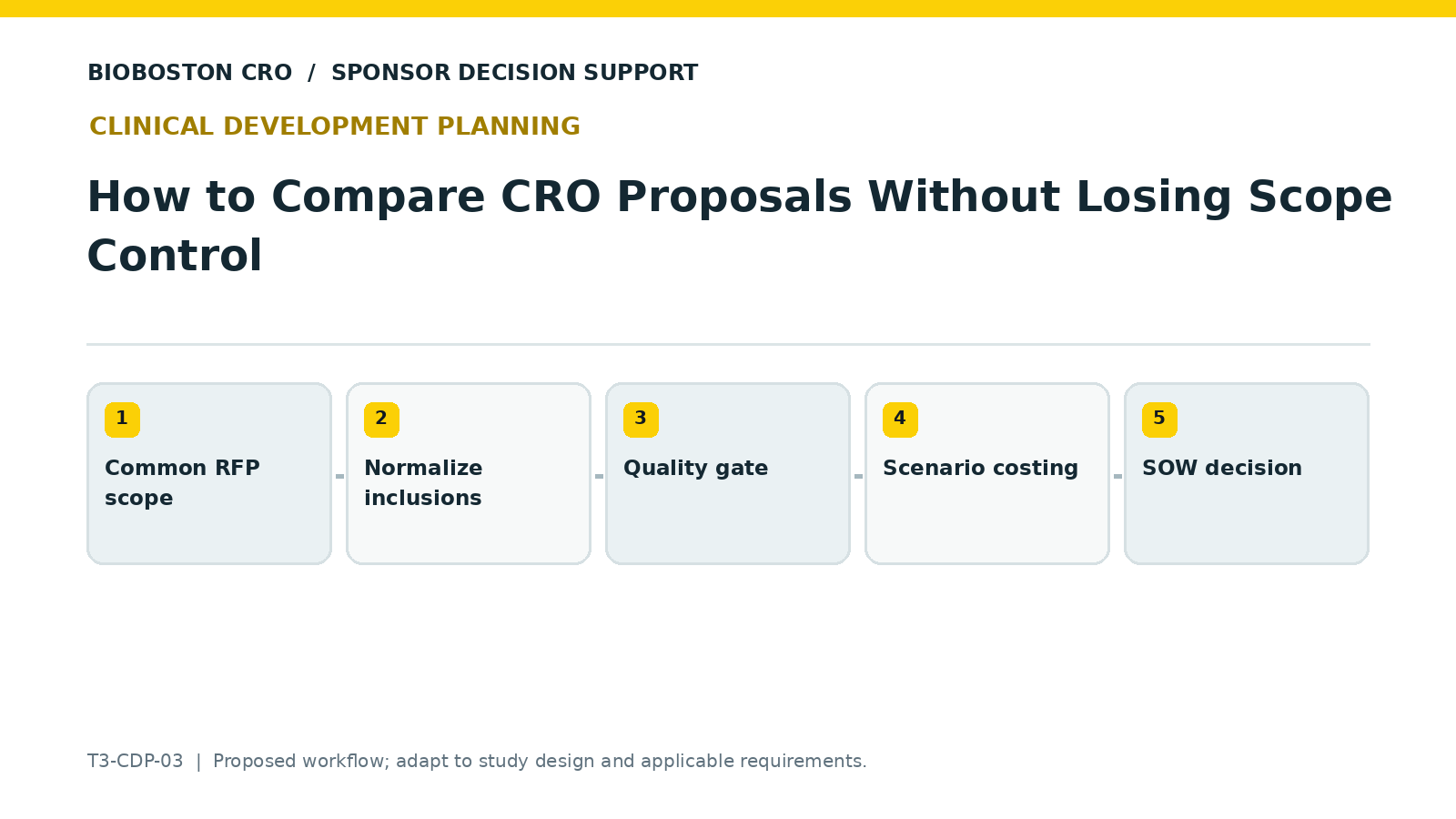
This sponsor-side comparison framework is for emerging biotech executives and Clinical Operations leaders choosing an outsourcing structure. It focuses on a documented award decision and defensible statement of work, not a generic list of questions to ask CROs.
What the sponsor needs to decide
Start with one approved request-for-proposal baseline and a common study scenario. Normalize every response to the same expected countries, sites, patients, visits, systems, deliverables and decision rights. Do not score a bidder higher for omitting activities that the trial still requires.
How to Compare CRO Proposals Without Losing Scope Control: evidence and decision matrix
| Review point | Evidence to collect | Sponsor decision or acceptance criterion |
|---|---|---|
| Trial scope and assumptions | Protocol version, populations, enrollment, countries, sites, visit count and startup scope | Every bid uses the same baseline or identifies a priced deviation. |
| Included vs excluded services | Functional scope by startup, monitoring, safety, data, stats, writing and closeout | Each required deliverable has an explicit provider and funding owner. |
| Effort and unit rates | FTE/hours, visit assumptions, pass-through units, overtime and escalation rates | Price risk is evaluated using plausible delivery volume. |
| Governance and accountability | Transfer of duties, RACI, sponsor oversight, quality metrics and issue escalation | The model supports retained sponsor decisions and inspection-ready records. |
| Data, technology and transition | EDC/eTMF/CTMS licensing, access, export, validation and exit obligations | Ownership, access and usable handoff data are contractually clear. |
| Change-order mechanisms | Definitions of in-scope work, amendments, enrollment delays and unforeseen costs | Variations are classified consistently and approval authority is stated. |
| Delivery team and partners | Named functional leads, subcontractor role, availability and ramp-up plan | Selection considers actual qualified delivery capacity, not only sales credentials. |
| Risk-adjusted total cost | Base fee, pass-throughs, sponsor-retained work, contingency and scenarios | Award decision uses a normalized total-to-complete range. |
How to apply this framework to a real sponsor decision
Create a zero-based scope matrix
List each required activity and deliverable independently of any bidder proposal. Mark included, separately priced, subcontracted, excluded or unclear. Ask bidders to price the same missing activities so the comparison is on equal terms.
Build a sensitivity view
Recalculate expected cost under slower enrollment, extra sites, additional monitoring needs, protocol amendment and extended database support. Not every scenario needs a single forecast; ranges and explicit triggers are more honest.
Evaluate execution evidence
Meet the proposed functional leads and verify who will actually do the work. Ask how vendor interfaces, quality risks and sponsor decisions will be handled. Where qualified partners deliver on-site or specialist components, make roles and responsibilities transparent.
Separate commercial and quality gates
First confirm that each option satisfies safety, data-quality and operational non-negotiables. Then evaluate total cost, flexibility and service fit. Do not give the lowest price enough weight to erase a critical operational gap.
Make the winning proposal contract-ready
Convert bid assumptions into measurable SOW deliverables, acceptance criteria, responsibility tables, change-control logic, access/exit obligations and escalation procedures. Record all deviations from the common RFP baseline.
Warning signs that need intervention
- A low bid excludes data management, safety or vendor pass-throughs assumed in other bids.
- The sponsor compares hours without comparing what the hours are meant to deliver.
- CRO subcontractors are not disclosed or governed in the responsibility map.
- A change-order clause is ambiguous about normal enrollment variability.
- The proposal specifies a team that is not committed or available at kickoff.
First-week sponsor action plan
- Freeze a common study scope and bidder assumption log.
- Normalize bids into included, excluded and separately priced work packages.
- Score safety and quality gates before comparing risk-adjusted cost.
- Turn accepted assumptions and change triggers into the signed SOW.
To connect this decision framework to actual study responsibilities, see BioBoston CRO Clinical Development Planning support. The service team can help structure sponsor oversight and the evidence needed to make a documented decision; site-facing or other specialized execution may be coordinated with qualified partners where appropriate.
Frequently asked sponsor questions
Should we compare hourly rates or total fees?
Both can be useful, but the decision should consider normalized deliverables, total-to-complete scenarios and risk allocation.
How should we handle pass-through costs?
Identify the responsible party, estimate basis, markup, approval threshold, invoice evidence and what happens when volume changes.
Can a lower-priced FSP or hybrid model be better?
Yes, if the sponsor has the retained governance and functional capacity needed. Compare operating-model fit as well as price.
Technical and regulatory context
The framework reflects relevant FDA/ICH principles, including ICH E6(R3), 21 CFR 312.50, 21 CFR 312.52. Guidance documents contain nonbinding recommendations and should not be described as universal legal requirements. Applicable binding obligations and study-specific authority expectations should be assessed separately; retain current source/version records in the internal quality file.
Next step for the sponsor
If your team is resolving the decisions above, explore BioBoston CRO Clinical Development Planning services for a scoped assessment, responsibility map or expert-supported working plan. Keep the decision record and supporting evidence even if you ultimately use another delivery model.