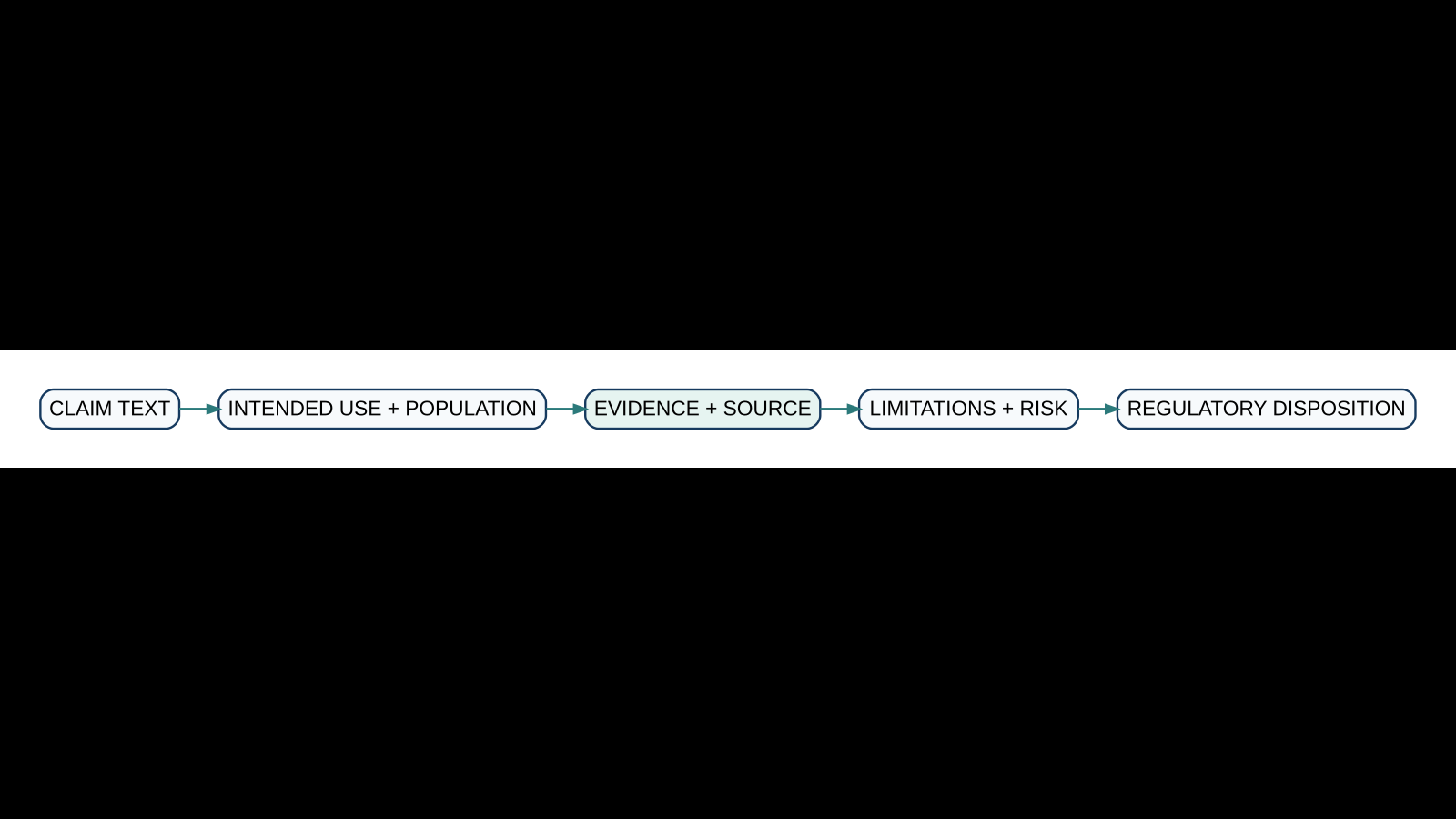
Claims evidence matrix work gives Regulatory Affairs a controlled way to answer a deceptively simple question: what evidence supports this exact labeling claim, for this product, population, use condition, and market?
The matrix is most useful before label wording is frozen. It exposes unsupported extrapolation, evidence that applies only to a narrower population, missing limitations, inconsistent claim wording, and unclear approval ownership while there is still time to resolve them.
Quick answer: what fields belong in a claims-to-evidence matrix?
Include the exact claim text, labeling location, intended use/indication, target population/user, evidence source and version, study/design context, quantitative result, relevant limitations, risk/consistency check, regulatory status, reviewer/owner, final disposition, and any wording conditions.
Who this framework is for
This template is for Regulatory Affairs leaders and product teams managing drug, biologic, medical-device, or diagnostic labeling. The evidence and regulatory criteria must be adapted to the product type and jurisdiction.
1. Copyable claims-to-evidence matrix
| ID | Exact claim | Use/population | Evidence source | Result | Limitations | Regulatory status | Owner | Disposition |
|---|---|---|---|---|---|---|---|---|
| CLM-001 | [verbatim wording] | [intended use/population] | [report/version] | [key quantitative/qualitative support] | [boundary/limitation] | [proposed/submitted/authorized/etc.] | [role] | Approve / revise / reject / hold |
2. Field-by-field instructions
Exact claim text
Paste the wording exactly as proposed. Small modifiers such as “rapid,” “improved,” “reduces,” “more accurate,” or “clinically meaningful” can change the evidence burden.
Intended use, population, and conditions
Record who uses the product, for whom, under what conditions, and for what purpose. Evidence generated in one population or configuration should not be assumed to support a broader claim.
Evidence source
Identify the controlled report, study, analysis, validation, literature package, or other source. Record version/date or data cutoff so the matrix is reproducible.
Result and effect size
Capture the result relevant to the claim, not every study output. Where a claim implies magnitude or comparison, record the quantitative basis and uncertainty needed for review.
Limitations
Document important exclusions, subgroup constraints, study-design limitations, device configuration, testing conditions, or other boundaries that affect interpretation.
Regulatory status
Track whether the wording/evidence is exploratory, under internal review, included in a submission, authorized/cleared/approved, or market-specific. Do not use one market’s disposition as automatic authority for another.
3. Add a consistency check
For each claim, compare the proposed wording with risk information, instructions for use, product description, performance/clinical summaries, and other labeling components. A claim should not create a contradiction elsewhere.
When evidence synthesis is complex, BioBoston CRO’s Safety and Efficacy Summaries support can help organize the source base before final claim review.
4. Use disposition rules
| Disposition | Use when | Required next step |
|---|---|---|
| Approve | Evidence and regulatory basis support exact wording | Route into controlled labeling approval |
| Revise | Evidence supports a narrower or qualified claim | Rewrite and re-review |
| Reject | Evidence does not support the claim | Remove from labeling |
| Hold | Evidence or regulatory decision is pending | Assign owner and trigger for re-review |
5. Hypothetical example
Hypothetical only: a device team proposes “improves detection of condition X.” The pivotal evidence shows improved sensitivity in a defined high-risk population compared with the sponsor’s prior method, but not across all intended users. The matrix records the exact study population, comparator, effect size, limitations, and regulatory status. Regulatory revises the proposed wording so it does not imply support beyond the studied population.
6. Governance and update rules
- Assign one unique claim ID that follows the wording through review.
- Version-control the matrix with the labeling package.
- Require evidence-source version/date.
- Reopen claims when new safety/performance evidence changes the support or limitation.
- Link change control to the matrix when product configuration or intended use changes.
- Keep final Regulatory disposition traceable.
7. Common matrix failure modes
- Using paraphrased claims instead of exact wording.
- Citing a study without recording the relevant result or limitation.
- Assuming a statistically significant result automatically supports a labeling claim.
- Missing population/configuration differences.
- Not reconciling claims with risk statements or instructions.
- Continuing to use superseded evidence versions.
Claims evidence matrix: final review gate
- Every material claim has a unique ID.
- Exact wording is captured.
- Evidence is controlled and traceable.
- Population/conditions match the claim.
- Limitations are visible.
- Cross-label consistency is checked.
- Regulatory status and disposition are documented.
- Open/held claims have owners and triggers.
Need help applying the matrix?
Explore BioBoston CRO Labeling Support for claims review, evidence traceability, labeling impact assessment, and controlled approval. For pathway questions, see Regulatory Pathway.