Clinical trial protocol review checklist work should test whether the protocol is internally coherent, scientifically defensible, and operationally executable. A document can read well and still contain cross-functional inconsistencies that create site questions, database rework, protocol deviations, or amendments.
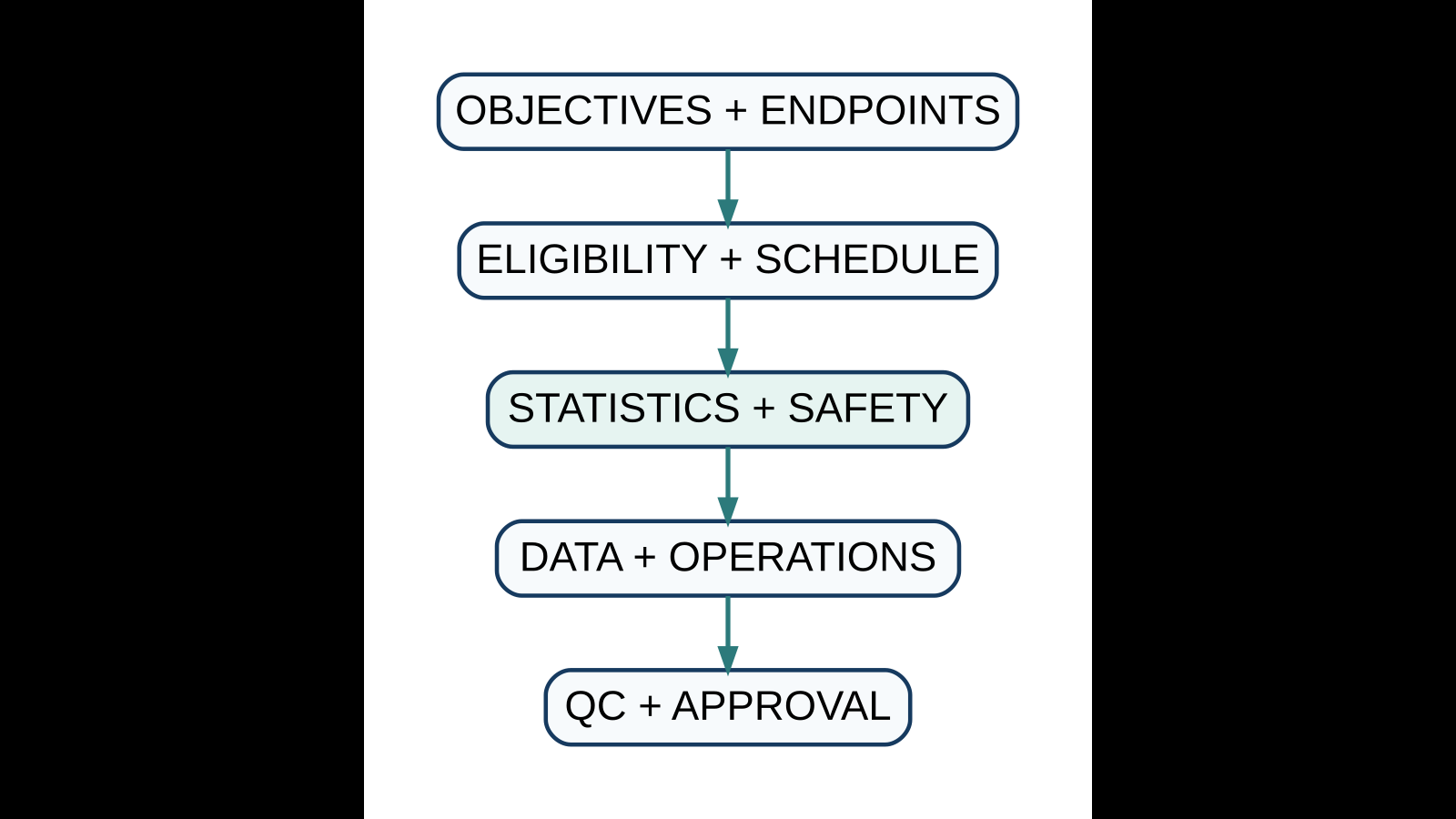
The highest-value review is not a line edit. It traces each major study decision across objectives, endpoints, eligibility, treatment, schedule, statistics, safety, data collection, and operational instructions.
Quick answer: what should a protocol QC review cover?
Review scientific alignment, cross-section consistency, operational feasibility, data traceability, safety logic, statistical compatibility, and document control. Use the checklist below before sponsor approval and again after substantive late-stage edits.
Who this checklist is for
This resource is for CMOs, Clinical Development, Clinical Operations, biostatistics, and Regulatory leaders preparing Phase I or II protocols, particularly first-in-human or early-phase studies where dose, safety, and operational assumptions are tightly coupled.
1. Objectives and endpoints
| Review item | Evidence / owner | Red flag |
|---|---|---|
| Each objective maps to an endpoint | Clinical + Statistics | Endpoint appears in analysis or schedule but not in objectives |
| Endpoint definition is consistent | Protocol, synopsis, statistical concept | Different timepoint, unit, responder rule, or assessment method |
| Exploratory assessments are labeled appropriately | Clinical Development | Exploratory measure is treated like a primary decision criterion elsewhere |
2. Eligibility criteria
Check that every inclusion/exclusion criterion has a clear scientific, safety, or operational rationale; that thresholds are consistent with the schedule and screening procedures; and that criteria do not contradict the target population described elsewhere.
- Confirm laboratory thresholds, units, timing, and repeat-testing rules.
- Check prior/concomitant therapy and washout periods.
- Align contraception and pregnancy testing requirements across sections.
- Ensure eligibility can be captured and source-verified consistently.
3. Schedule of activities
Cross-check every scheduled assessment against the narrative sections. Confirm visit windows, conditional procedures, PK/PD timing, imaging/lab requirements, and the distinction between screening, baseline, treatment, follow-up, and unscheduled assessments.
If the schedule cannot be translated cleanly into data collection, use eCRF Design and Review to identify protocol-to-database inconsistencies early.
4. Statistics and decision rules
- Sample-size rationale matches cohort structure and objectives.
- Analysis populations are compatible with eligibility and treatment rules.
- Primary timepoints match the schedule.
- Escalation, futility, stopping, or expansion criteria are mathematically and operationally executable.
- Randomization/stratification factors appear consistently.
5. Safety architecture
Review adverse-event collection periods, AESIs, laboratory/ECG monitoring, dose modifications, DLT definitions, stopping rules, urgent safety actions, pregnancy management, overdose, and safety-review responsibilities. Confirm the protocol is consistent with the current Investigator’s Brochure and known product risks.
6. Treatment and dose instructions
Sites should not need to infer what happens when treatment is delayed, missed, interrupted, reduced, escalated, or discontinued. Check preparation/administration instructions, cohort assignment, replacement rules, supportive therapy, and prohibited medications.
7. Operational feasibility
| Question | Owner | Failure signal |
|---|---|---|
| Can sites perform all assessments in the stated windows? | Clinical Operations | Feasibility feedback requires informal exceptions |
| Are vendors/labs ready for protocol requirements? | Operations/Vendor lead | Vendor capability assumed but not confirmed |
| Can monitoring verify the key criteria and endpoints? | Clinical Ops/QA | Critical evidence has no clear source |
| Can the database capture every required datum? | Data Management | Protocol language cannot be translated into fields or rules |
8. Cross-document consistency
Compare the protocol against the synopsis, IB, informed consent concept, statistical plan concept, pharmacy/manual instructions, vendor specifications, and relevant regulatory commitments. Not every document needs identical wording, but the underlying scientific and operational meaning must agree.
9. Late-change control
After substantive review, use a controlled issue log. Classify each comment as scientific, regulatory, safety, statistical, operational, data, or editorial. Resolve substantive comments before final copyediting and rerun targeted cross-reference checks after each accepted late change.
Common review failures
- Reviewers edit only their own section and miss cross-functional dependencies.
- Schedule changes are not propagated to endpoint or safety text.
- Eligibility thresholds use inconsistent units.
- Dose or stopping rules differ between narrative sections and tables.
- Statistics are reviewed only after the clinical design is frozen.
- Final QC is used to resolve strategy rather than verify the approved strategy.
Clinical trial protocol review checklist: sponsor approval gate
- Objectives, endpoints, timepoints, and analysis concepts align.
- Eligibility is rationalized and operational.
- Schedule matches all narrative requirements.
- Treatment and safety contingencies are executable.
- Statistical rules match cohort and endpoint design.
- Data and vendor feasibility are confirmed.
- Critical cross-document inconsistencies are resolved.
- All substantive changes received targeted re-review.
Need help with protocol review and finalization?
Explore BioBoston CRO Protocol Writing support for development, integrated review, amendment support, and independent QC. Related support includes Regulatory Pathway and Clinical Project Management.