FDA labeling checklist review should begin with a basic question: what product and regulatory context does this label, labeling, or IFU belong to? Drug, biologic, medical-device, and IVD labeling are not interchangeable, and the applicable requirements depend on product type, intended use, development/marketing status, and the specific labeling component being reviewed.
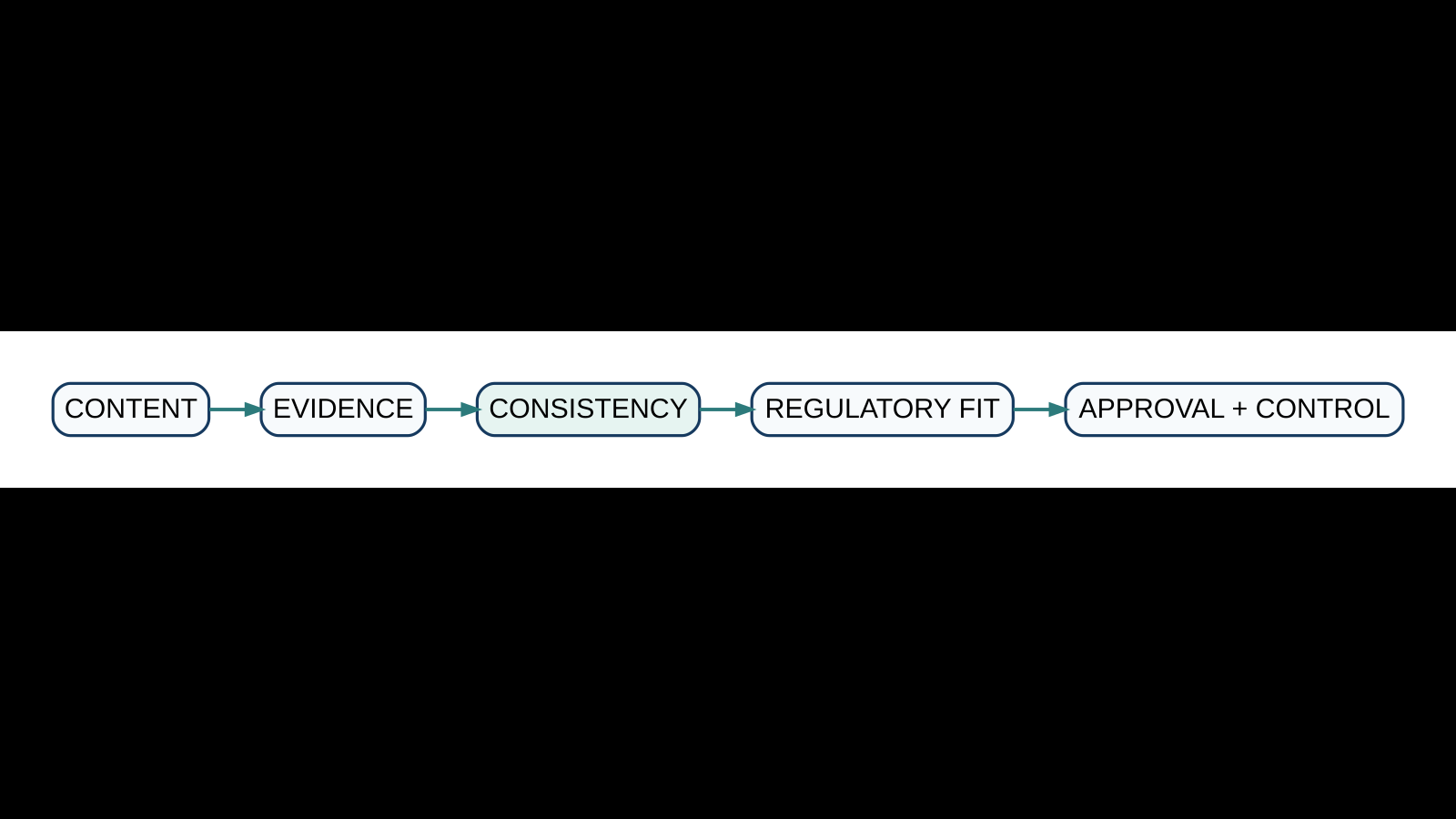
A strong review therefore tests four things together: the content itself, the evidence supporting claims and instructions, consistency with the approved or proposed regulatory position, and the controls used to approve and implement the labeling.
Quick answer: what should an FDA labeling review cover?
Confirm product/regulatory applicability, required content, intended use/indications, claims and evidence, directions/instructions, warnings/precautions, consistency across labeling components, traceability to approved source information, version control, review/approval ownership, and downstream change implementation.
Who this checklist is for
This checklist is for Regulatory Affairs leaders and product teams managing drug, biologic, device, or diagnostic labeling decisions from development through market access. Product-specific review by the appropriate Regulatory SME is essential where requirements differ.
1. Identify the labeling object and regulatory state
| Review field | Evidence / owner | Red flag |
|---|---|---|
| Product type/classification | Regulatory strategy / authorization record | Reviewer assumes requirements based on another product category |
| Labeling component | Label, carton, IFU, package insert, electronic content, etc. | Different components use inconsistent source content |
| Regulatory status | Investigational, submitted, authorized/cleared/approved | Commercial language appears in investigational materials without assessment |
| Market/jurisdiction | Country-specific requirements | One global master is released without local applicability review |
2. Verify intended use, indications, and claims
Every claim should be traceable to the appropriate evidence and regulatory basis. Check that claims do not expand beyond the supported intended use, indication, population, setting, performance, or benefit-risk position.
- Define the exact claim text.
- Identify the supporting study/report/analysis.
- Confirm the population and conditions of use match the evidence.
- Check consistency with approved/cleared/submitted regulatory language where applicable.
- Flag promotional or comparative language for appropriate review.
3. Review directions, instructions, and user actions
Instructions should be usable by the intended user and consistent with product design and risk controls. For devices/IVDs, check preparation, setup, operating steps, specimen/sample requirements where relevant, limitations, storage, maintenance, interpretation, and disposal. For drugs/biologics, apply the appropriate product labeling framework rather than device rules.
4. Review warnings, precautions, contraindications, and limitations
Trace risk-related statements to current safety/risk-management information and confirm the same concept is expressed consistently in all relevant labeling components. An omitted or softened risk statement can be as important as an added claim.
5. Cross-document consistency check
| Compare against | What to reconcile |
|---|---|
| Regulatory submission/authorization | Intended use, indications, claims, conditions of use |
| Risk-management file | Warnings, precautions, user risk controls |
| Clinical/performance evidence | Claim magnitude, population, limitations |
| Product specifications | Configuration, components, storage, operating parameters |
| Other labeling components | Terminology, symbols, instructions, contact/manufacturer information |
6. Evidence and claim traceability
Do not rely on reviewer memory. Maintain a claim/evidence record showing the exact label statement, supporting evidence, source version, regulatory disposition, and approval owner. BioBoston CRO’s Safety and Efficacy Summaries support can help when evidence synthesis is part of the labeling rationale.
7. Approval and document control
- Use defined Regulatory, Medical/Clinical, Quality, Safety, Legal/Promotional, and product-owner roles as applicable.
- Lock the source-of-truth labeling version before release.
- Record approval and effective date.
- Control superseded versions and market-specific variants.
- Assess downstream inventory, training, digital content, and submission impacts before implementation.
8. Common labeling review gaps
- Claims are supported generally, but not for the exact population or condition of use.
- The IFU and carton use different terminology.
- Risk statements are not reconciled with current evidence.
- UDI or product-identification elements are treated as an afterthought.
- A product change is approved without labeling impact assessment.
- The team cannot reconstruct who approved the released wording.
FDA labeling checklist: approval gate
- Applicable product/jurisdiction requirements are identified.
- Required content is present.
- Claims are traceable to evidence.
- Directions and risk information are internally consistent.
- Labeling matches the relevant regulatory position.
- Cross-functional approvals are complete.
- Version/effective-date controls are documented.
- Downstream implementation impacts are assessed.
Need help applying this to your product?
Explore BioBoston CRO Labeling Support for product-specific labeling review, evidence alignment, change assessment, and approval controls. For broader pathway decisions, see Regulatory Pathway.