integrated summary of safety and efficacy planning should help the sponsor make a controlled decision, not merely create another document. A sponsor-side comparison of the Integrated Summary of Safety (ISS) and Integrated Summary of Effectiveness (ISE). Use it to align source studies, analyses, cutoffs, owners, and cross-study interpretation before submission writing accelerates.
Quick answer: how do ISS and ISE differ?
| Dimension | ISS | ISE |
|---|---|---|
| Primary question | What does the integrated evidence show about safety and risk? | What does the integrated evidence show about effectiveness for the proposed use? |
| Typical inputs | Exposure, AEs, SAEs, deaths, discontinuations, labs, vitals, ECGs, AESIs, special populations | Endpoints, estimands, analysis populations, effect sizes, sensitivity analyses, subgroups, study design |
| Cross-study challenge | Different follow-up, coding, exposure duration, collection intensity | Different designs, endpoints, populations, comparators, timepoints |
| Main planning risk | Pooling incompatible safety data without a defensible rationale | Combining efficacy evidence that answers different clinical questions |
1. Start with one integrated evidence map
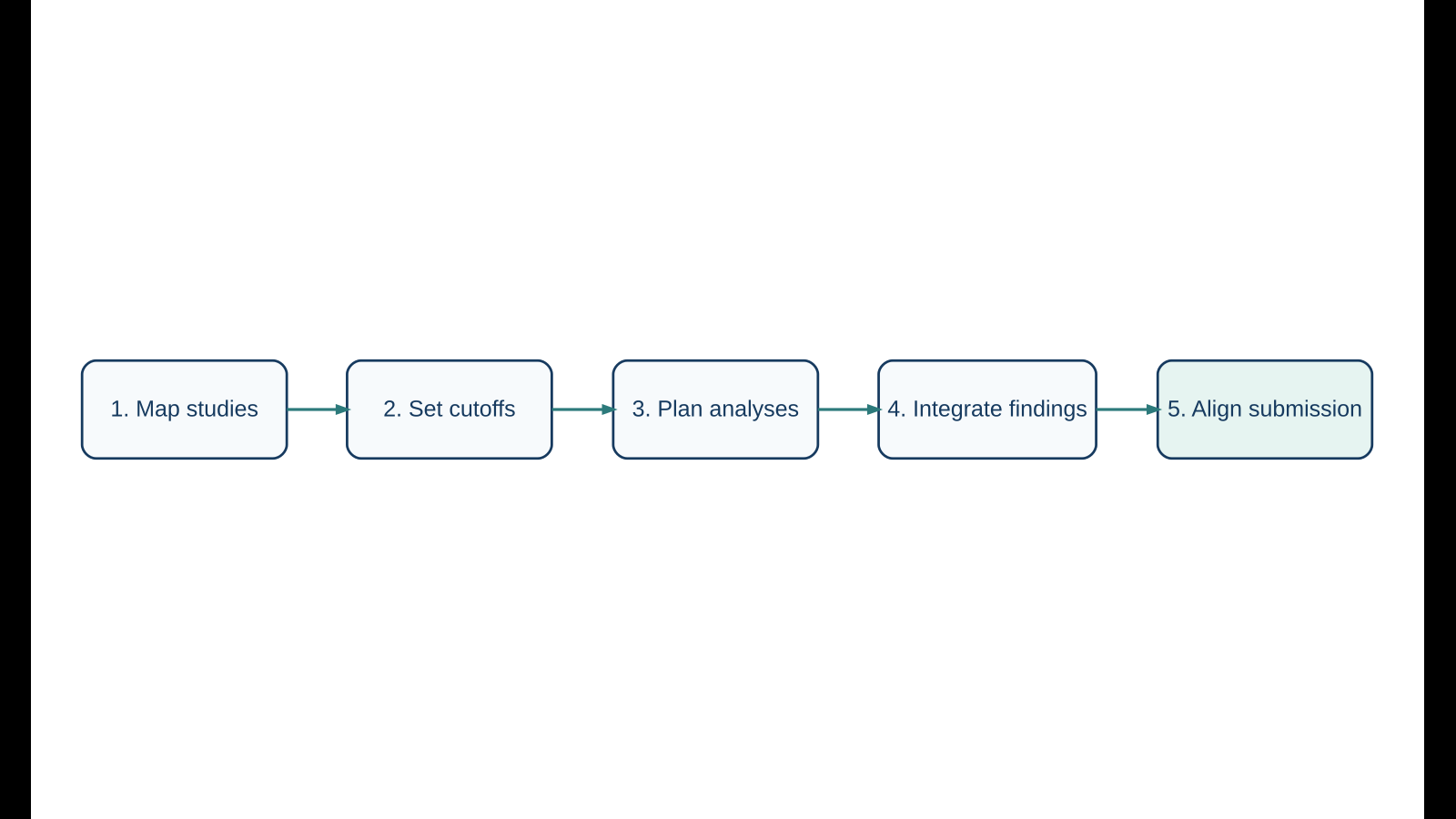
Before separate authoring teams begin, map every study and dataset to the regulatory question it can support. Identify pivotal versus supportive evidence, data cutoffs, analysis populations, coding conventions, and known limitations. The map should show where safety and effectiveness use the same study but require different integration logic.
For sponsors that need hands-on support applying this framework, BioBoston CRO Safety and Efficacy Summaries can support the underlying regulatory and cross-functional work.
2. Lock analysis conventions early
- Define study groupings and pooling rules before final tables are generated.
- Document the safety population and exposure conventions.
- Define efficacy estimands, endpoint hierarchy, and analysis populations.
- Identify where studies cannot be pooled and require side-by-side interpretation.
- Use one controlled data-cutoff register across clinical, safety, statistics, and writing.
3. Plan the interfaces, not only the documents
| Interface | Question to resolve |
|---|---|
| ISS ↔ ISE | Do benefit and risk use compatible populations and cutoffs where cross-reference is needed? |
| Module 2 ↔ Module 5 | Which integrated conclusions are summarized, and where is the detailed support located? |
| Integrated summary ↔ labeling | Which conclusions may affect proposed indications, warnings, limitations, or other labeling? |
| Statistics ↔ writing | Who owns interpretation when pooled analyses and study-level narratives appear to conflict? |
4. Treat cross-study inconsistency as an analysis topic
A difference between studies is not automatically a defect. The sponsor should distinguish explainable heterogeneity from unresolved inconsistency. Differences in population, dose, follow-up, endpoint definition, geography, background therapy, or study conduct may legitimately alter results. The integrated narrative should make those drivers visible.
5. Use separate but coordinated governance
- One accountable owner for integrated safety interpretation.
- One accountable owner for integrated effectiveness interpretation.
- Shared issue log for data cutoffs, coding, study inclusion, and cross-references.
- Defined escalation route for material disagreements between Clinical, Safety, Statistics, and Regulatory.
- A final consistency review against the proposed regulatory position and labeling.
Planning red flags
- ISS and ISE teams use different study inventories.
- Final pooled tables are produced before pooling rules are documented.
- Important negative or inconsistent studies are discussed only in study reports, not integrated interpretation.
- Narrative conclusions are stronger than the analysis populations or study designs support.
- Late labeling changes create unplanned re-analysis or rewriting.
Need help integrating the evidence?
BioBoston CRO Safety and Efficacy Summaries support can cover integrated planning, source coordination, summary development, or independent cross-study review.