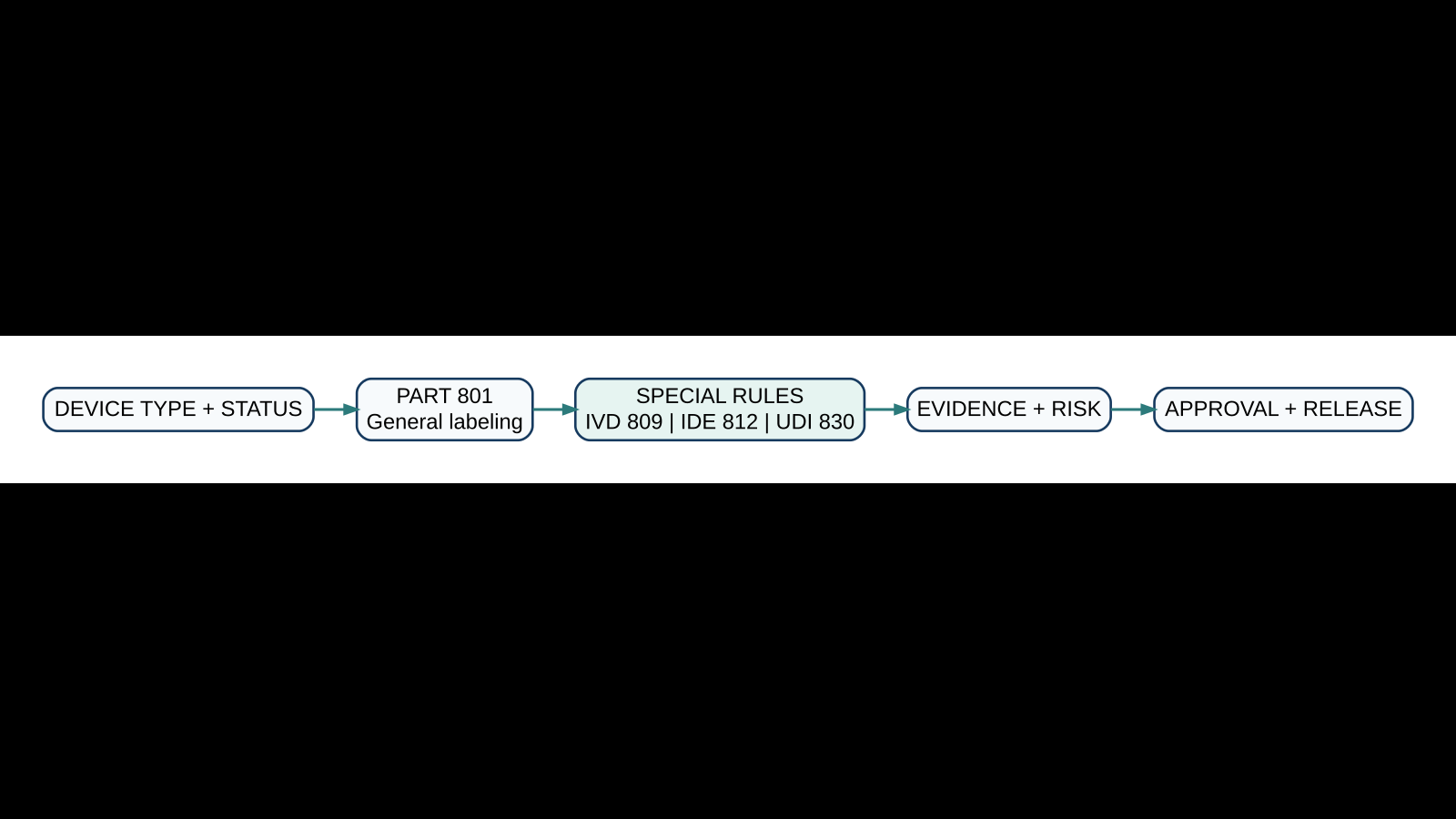
Medical device labeling requirements in the United States begin with 21 CFR Part 801, but a sponsor or manufacturer may also need to account for other product-specific requirements. IVD labeling is addressed in Part 809, investigational-device requirements in Part 812, and unique device identification requirements in Part 830, where applicable.
The practical challenge is not only identifying a regulation. It is translating the applicable requirements into controlled label, labeling, IFU, packaging, electronic, and change-review decisions for the specific device.
Quick answer: what should a U.S. medical device labeling review include?
Confirm the applicable regulatory parts, manufacturer/business identification, intended use and adequate directions/instructions as applicable, required warnings/limitations, truthful and nonmisleading presentation, device-specific content, UDI requirements where applicable, consistency with the authorized/cleared/approved regulatory position, and controlled approval/release.
Who this guide is for
This guide is for Regulatory Affairs leaders and product teams responsible for U.S. medical-device or diagnostic labeling from development through commercialization. It is a practical review tool, not a substitute for device-specific legal/regulatory assessment.
1. Start with device type and regulatory status
| Question | Why it matters |
|---|---|
| Is the product a general medical device or IVD? | IVDs have additional Part 809 labeling requirements. |
| Is it investigational? | IDE labeling restrictions/requirements may apply. |
| Is UDI required? | Part 830 and related requirements may affect label content/data. |
| What authorization/clearance/approval applies? | Labeling must align with the relevant regulatory decision and evidence. |
2. General Part 801 review
FDA’s device-labeling framework includes requirements addressing label/labeling content, adequate directions for use where applicable, manufacturer/packer/distributor identification, intended use, prominence, and prohibitions against false or misleading labeling. The exact provisions that apply depend on the device and exemptions.
Sponsor review actions
- Identify the exact legal manufacturer/distributor information required.
- Confirm intended-use language and indications match the regulatory record.
- Review directions/instructions for the intended user and use environment.
- Check warnings, precautions, contraindications, limitations, storage, and handling as applicable.
- Confirm required statements are prominent and readable.
- Review claims for truthfulness and evidence alignment.
3. IVD-specific Part 809 review
For in vitro diagnostic products, Part 809 contains additional labeling requirements, including detailed content for the immediate container and labeling/package insert as applicable. Review intended use, specimen type, methodology, reagents/materials, warnings/precautions, storage/stability, procedures, calculations/interpretation, performance characteristics, limitations, and other required information based on the product.
4. Investigational-device labeling
If the device is used under an investigational device exemption or other investigational context, confirm Part 812 requirements and restrictions. Avoid commercial/promotional claims that are inconsistent with investigational status and ensure the label/labeling accurately identifies the investigational context as required.
5. Unique Device Identification
Assess whether the device and packaging levels require UDI and whether any exception or alternative applies. Confirm the UDI implementation is consistent with label artwork, packaging hierarchy, data-submission responsibilities, and product configuration.
6. Evidence and intended-use alignment
| Label element | Evidence/source to verify | Red flag |
|---|---|---|
| Intended use/indications | Submission/authorization and device description | Broader use than reviewed by FDA |
| Performance claim | Clinical/analytical/performance evidence | Claim magnitude exceeds supporting data |
| Warning/limitation | Risk analysis, complaints, clinical evidence | Known limitation absent from user-facing labeling |
| Operating instruction | Design validation/usability evidence | Instruction conflicts with validated use |
7. Labeling should match design and risk controls
Labeling is not independent of design controls, risk management, usability, packaging, software, accessories, and manufacturing configuration. A product change can invalidate a labeling assumption even if no marketing claim changes.
For difficult classification or pathway questions, BioBoston CRO’s Regulatory Pathway support can help define the broader regulatory context before labeling is finalized.
8. Common mistakes
- Applying general Part 801 requirements but missing IVD-specific Part 809 content.
- UDI is reviewed after artwork is already frozen.
- Claims are copied from marketing concepts without evidence traceability.
- Instructions do not match the validated device configuration.
- Warnings/limitations are inconsistent across label, IFU, and electronic materials.
- Investigational and commercial labeling are not clearly separated.
Medical device labeling checklist
- Device type/status and applicable CFR parts are identified.
- Required general/device-specific content is present.
- Intended use and claims match the regulatory/evidence basis.
- Instructions are usable and consistent with validated design.
- Warnings, limitations, and storage/handling are current.
- UDI applicability has been assessed.
- All labeling components use controlled, consistent terminology.
- Review/approval and effective version are documented.
Need help applying the requirements to your device?
Explore BioBoston CRO Labeling Support for product-specific review, evidence alignment, and labeling controls. Evidence synthesis can also be supported through Safety and Efficacy Summaries.