Protocol synopsis expansion should not be a mechanical exercise. A synopsis can be useful while several design choices are still provisional; a full protocol cannot safely carry the same level of ambiguity because sites, vendors, statisticians, data managers, monitors, and regulators will rely on it as an operational instruction set.
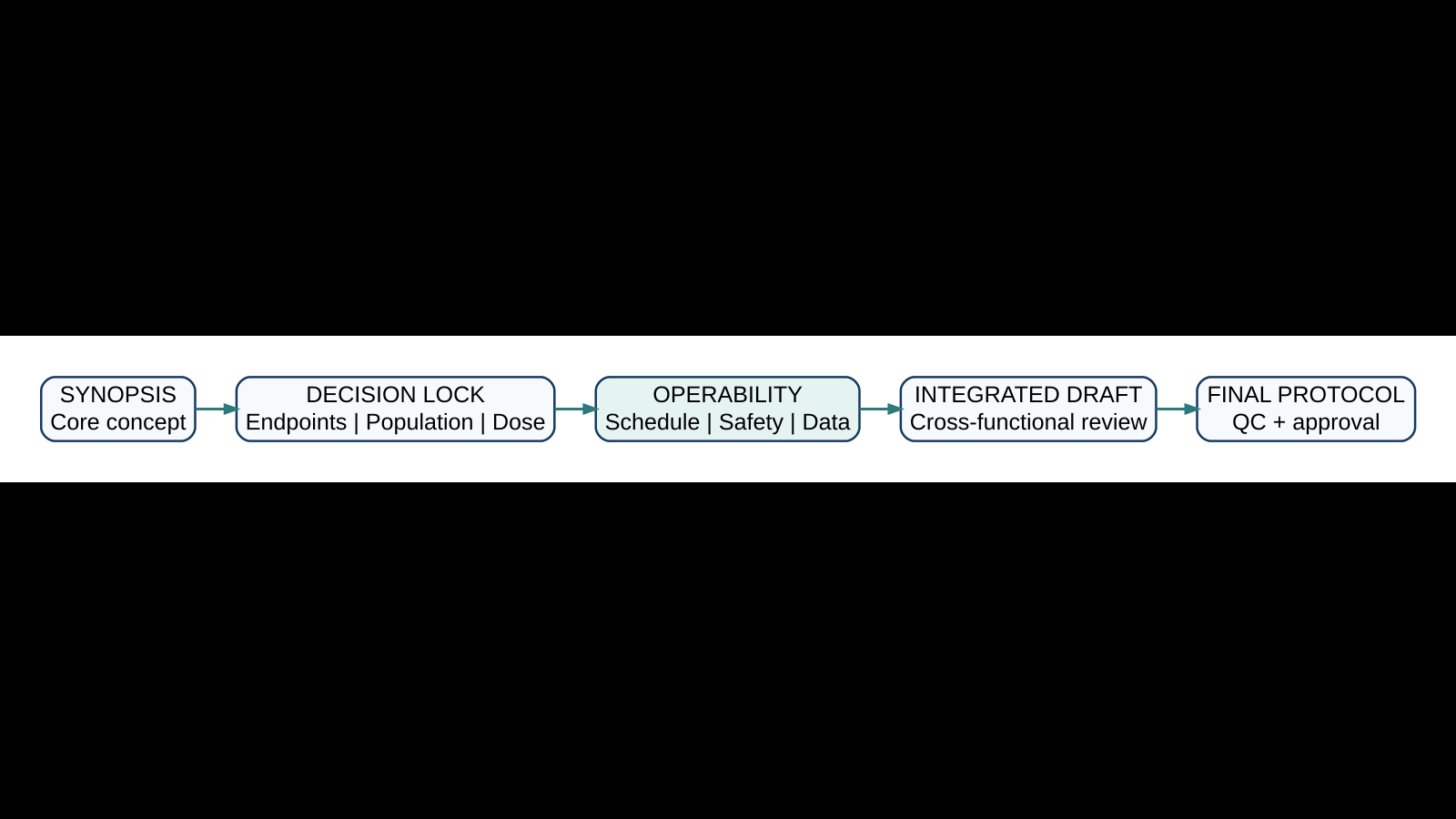
Before expanding the document, lock the decisions that have the greatest downstream impact: objectives and endpoints, population, treatment/dose strategy, assessment schedule, safety controls, statistical logic, and data/vender dependencies.
Quick answer: what must be finalized before a synopsis becomes a full protocol?
Finalize the study question, objectives/endpoints, target population and eligibility rationale, intervention and dosing, visit/assessment schedule, safety monitoring and stopping rules, statistical approach, operational assumptions, data requirements, and decision ownership. Some details can remain controlled placeholders, but only when the owner and resolution date are explicit.
Who this guide is for
This guide is for CMO, Clinical Development, Clinical Operations, biostatistics, and Regulatory leaders preparing Phase I or II protocols, especially first-in-human and other early-phase studies where the synopsis is often created before all operational inputs are mature.
1. Separate the synopsis decisions into three buckets
| Bucket | Meaning | Action before expansion |
|---|---|---|
| Locked | Decision is approved and supported | Draft directly into full protocol |
| Open but bounded | Options are limited and decision owner/timing are known | Use controlled placeholder or decision note |
| Unresolved / unbounded | Fundamental design direction is still uncertain | Resolve before full authoring accelerates |
2. Lock objectives and endpoints first
Objectives and endpoints drive eligibility, schedule, sample size, data collection, and interpretation. Confirm the exact endpoint definition, measurement method, analysis timepoint, and how the endpoint supports the stated objective. If the synopsis simply says “safety and tolerability” or “preliminary efficacy,” expand that concept into the specific assessments and decision logic the full protocol requires.
3. Finalize the population and eligibility rationale
Define whom the study is intended to enroll and why. Convert broad synopsis criteria into operational rules that sites can apply consistently. Resolve disease stage, prior treatment, laboratory thresholds, reproductive requirements, concomitant medication, washout periods, and exclusions tied to product risk.
4. Translate treatment concepts into executable rules
A synopsis may state dose levels and cohort sizes without describing every contingency. The full protocol needs instructions for dose administration, interruptions, missed doses, escalation/de-escalation, replacement, DLT evaluation, stopping, and safety-review decisions.
5. Build the schedule from endpoint and safety needs
Do not simply expand the synopsis visit list. Map each assessment to a reason: eligibility, endpoint, safety, PK/PD, operational, or regulatory. Remove unnecessary duplication and identify vendor/lab constraints before finalizing the schedule.
Use eCRF Design and Review when the protocol-to-data translation needs independent review before database build.
6. Confirm the statistical logic before prose hardens
- Primary and secondary endpoint analysis concepts.
- Analysis population definitions.
- Sample-size rationale.
- Interim, escalation, futility, or expansion rules.
- Handling of missing data and relevant intercurrent events.
- Randomization/stratification or cohort assignment logic when applicable.
7. Define safety architecture
Confirm adverse-event collection, laboratory review, special-interest events, dose modification, urgent safety actions, stopping rules, review committees, and how safety information changes enrollment. Keep the protocol consistent with the current IB and safety-management plans.
8. Create a synopsis-to-protocol handoff matrix
| Synopsis element | Full-protocol expansion needed | Owner | Ready? |
|---|---|---|---|
| Objective | Endpoint, timepoint, analysis linkage | Clinical/Statistics | Yes / No |
| Population | Operational eligibility definitions | Clinical/Safety | Yes / No |
| Dose/cohorts | Administration, escalation, stopping, replacement | Clinical/CMO | Yes / No |
| Visits | Windows, conditional assessments, vendor feasibility | Operations | Yes / No |
| Statistics | Decision and analysis rules | Biostatistics | Yes / No |
9. Common failure points
- Expanding the synopsis before endpoint language is final.
- Adding detailed eligibility criteria without rationale.
- Designing visit schedules without site/vendor feasibility.
- Allowing safety and dose rules to live in separate working notes instead of the protocol.
- Waiting until final review to involve Statistics or Data Management.
- Leaving ambiguous “TBD” items without owners or deadlines.
Protocol synopsis expansion: action checklist
- Classify every major synopsis decision as locked, bounded-open, or unresolved.
- Resolve critical objectives/endpoints before integrated authoring.
- Confirm population and eligibility logic.
- Make treatment and safety contingencies executable.
- Validate schedule and data feasibility.
- Assign owners to remaining bounded placeholders.
- Run one integrated cross-functional review before final QC.
Need help expanding a synopsis into a regulator-ready protocol?
Explore BioBoston CRO Protocol Writing support. For development-sequence questions, see Regulatory Pathway; for delivery governance, see Clinical Project Management.