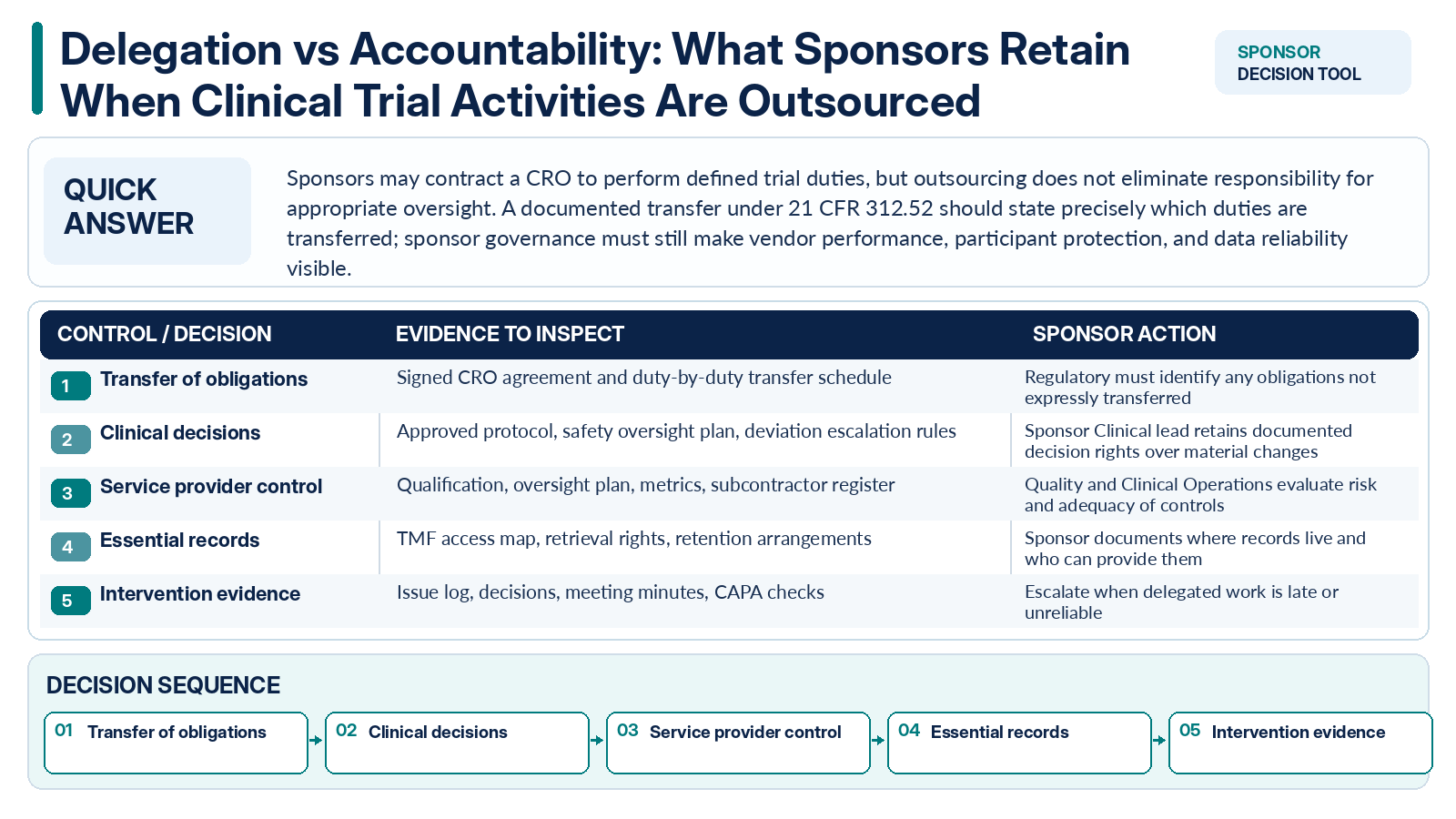
Sponsors may contract a CRO to perform defined trial duties, but outsourcing does not eliminate responsibility for appropriate oversight. A documented transfer under 21 CFR 312.52 should state precisely which duties are transferred; sponsor governance must still make vendor performance, participant protection, and data reliability visible.
Decision factors and what they mean
Begin with the most consequential control and the evidence needed to resolve it. The following matrix connects each decision to records and an accountable action, rather than treating the list as a generic compliance checkbox.
| Control / question | Evidence to examine | Sponsor action |
|---|---|---|
| Transfer of obligations | Signed CRO agreement and duty-by-duty transfer schedule | Regulatory must identify any obligations not expressly transferred |
| Clinical decisions | Approved protocol, safety oversight plan, deviation escalation rules | Sponsor Clinical lead retains documented decision rights over material changes |
| Service provider control | Qualification, oversight plan, metrics, subcontractor register | Quality and Clinical Operations evaluate risk and adequacy of controls |
| Essential records | TMF access map, retrieval rights, retention arrangements | Sponsor documents where records live and who can provide them |
| Intervention evidence | Issue log, decisions, meeting minutes, CAPA checks | Escalate when delegated work is late or unreliable |
For teams that need support implementing this across functions, BioBoston CRO Sponsor Oversight can help adapt the controls to the study, vendors, and decision calendar.
Working through the controls
1. Transfer of obligations
Evidence: Signed CRO agreement and duty-by-duty transfer schedule. Decision: Regulatory must identify any obligations not expressly transferred. Record the responsible function and the approved source version, and keep any remaining exceptions visible to the sponsor before this item is closed.
2. Clinical decisions
Evidence: Approved protocol, safety oversight plan, deviation escalation rules. Decision: Sponsor Clinical lead retains documented decision rights over material changes. Record the responsible function and the approved source version, and keep any remaining exceptions visible to the sponsor before this item is closed.
3. Service provider control
Evidence: Qualification, oversight plan, metrics, subcontractor register. Decision: Quality and Clinical Operations evaluate risk and adequacy of controls. Record the responsible function and the approved source version, and keep any remaining exceptions visible to the sponsor before this item is closed.
4. Essential records
Evidence: TMF access map, retrieval rights, retention arrangements. Decision: Sponsor documents where records live and who can provide them. Record the responsible function and the approved source version, and keep any remaining exceptions visible to the sponsor before this item is closed.
5. Intervention evidence
Evidence: Issue log, decisions, meeting minutes, CAPA checks. Decision: Escalate when delegated work is late or unreliable. Record the responsible function and the approved source version, and keep any remaining exceptions visible to the sponsor before this item is closed.
Red flags that should change the plan
- Assuming the contract alone proves oversight.
- Multiple organizations believing another owns safety escalation.
- No practical access to vendor data or essential records.
Decision gate and governance
Before trial activation, approve a single delegation-versus-accountability table and test one realistic escalation from signal to sponsor decision. The control owner should record the decision, evidence version, date, residual uncertainty and next re-review trigger. Where delegated providers perform the work, the sponsor should retain the relevant oversight and acceptance evidence.
Regulatory note: Applicable regulations, trial commitments and agreements must be distinguished from nonbinding FDA and ICH guidance. Apply this framework to the actual product, jurisdiction and study.
Need practical support?
Use BioBoston CRO Sponsor Oversight to review the evidence, define decision rights, and build a study-specific action plan for the next milestone.