The path from IND clearance to first patient in is not a single 30-day countdown. For a US drug study that requires an IND, the sponsor must establish when the IND is in effect, secure the applicable IRB and site permissions, release the study systems and investigational product, confirm site capability, and verify the first participant can be screened and treated under the current protocol. The longest unresolved dependency determines the credible first-patient-in (FPI) forecast.
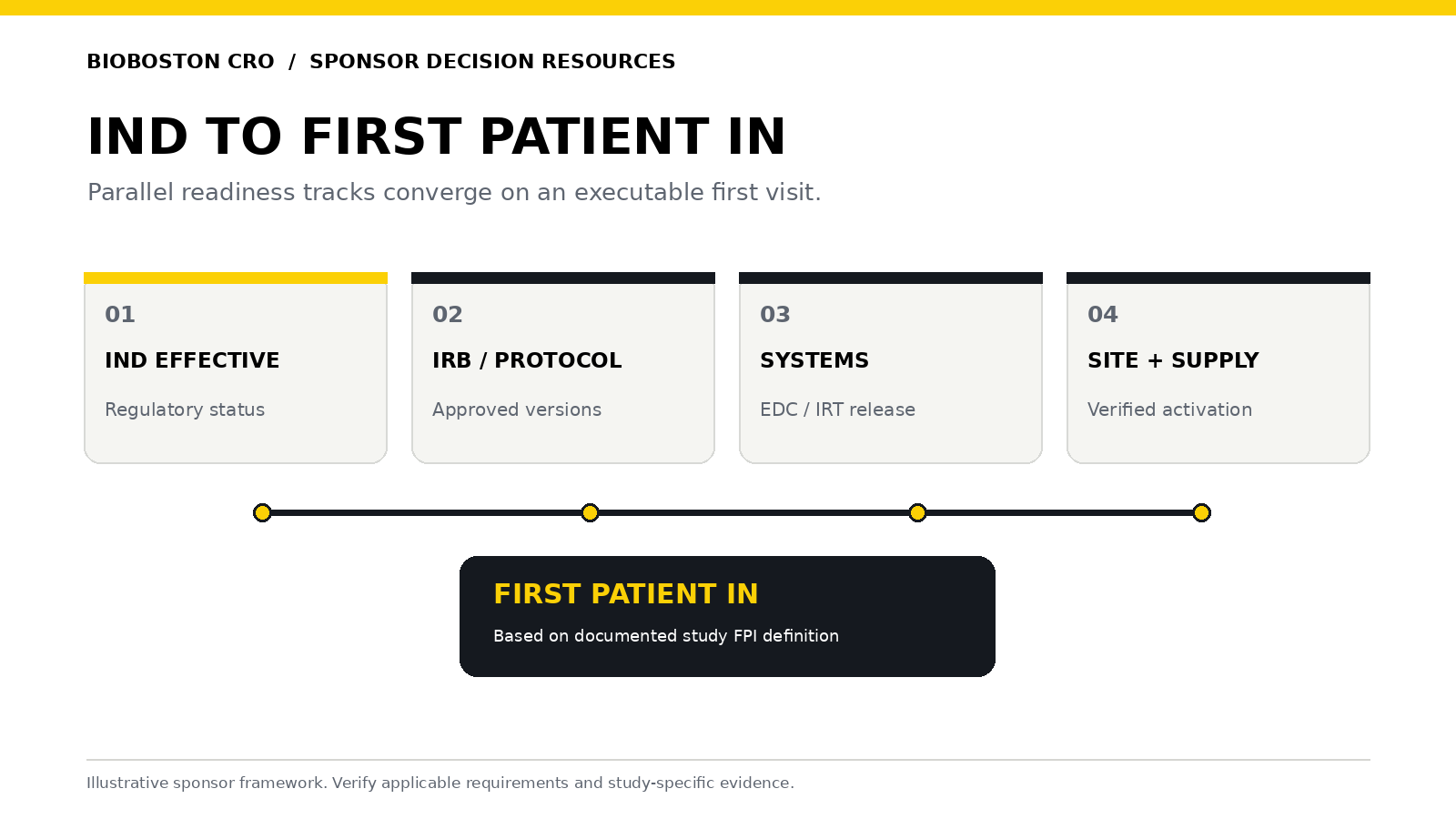
This critical-path guide is intended for lean sponsor teams planning a first-in-human or early-phase study. It identifies the decision gates, evidence and owner handoffs needed between an initial IND submission and actual study execution. Dates are project forecasts, not promises of regulatory clearance.
First distinguish IND effectiveness from FPI readiness
Under 21 CFR 312.40(b), an IND generally goes into effect 30 days after FDA receives it unless FDA places the investigation on clinical hold, or earlier if FDA notifies the sponsor that clinical investigations may begin. The effective-date rule does not substitute for applicable IRB approval, informed-consent requirements, protocol training, investigational product readiness or site requirements. A clinical hold prevents the restricted investigation from proceeding until FDA authorizes it; sponsors must manage hold correspondence through the appropriate regulatory process.
The phrase “IND clearance” is widely used informally. For project control, record IND effective / no clinical hold with the actual date and FDA correspondence or receipt evidence instead of assuming that FDA always issues an affirmative clearance letter. FDA’s review clock and the sponsor’s operational schedule are related but separate tracks.
For a trial subject to FDA IRB requirements, 21 CFR 56.103 generally requires IRB review and approval before initiation, subject to specified regulatory exceptions. Screening, informed consent, and dosing must follow the applicable approved protocol and permissions. Site-country variations and the product’s risk profile may add other gates.
A milestone map built around receiving-team acceptance
Use the following table as a working dependency register. The sequence is deliberately not a fixed number of weeks: many workstreams progress in parallel, and the actual critical path may change after the first site is selected. The evidence column is what allows the sponsor to close a gate.
| Critical-path gate | Predecessor / dependency | Acceptance evidence | Sponsor owner | Early warning |
|---|---|---|---|---|
| IND effective status confirmed | Receipt date, hold communication, regulatory assessment | Documented status and restrictions | Regulatory lead | Open FDA issue or unresolved hold |
| Protocol and consent ready | Final protocol, safety requirements, site-language localization | Approved, controlled versions / IRB determination | Medical + regulatory | Competing versions in circulation |
| Site selection and agreements | Qualification, staff capacity, budget and contracting | Executed agreements, investigator and facility readiness | Clinical operations | Site forecast based on unsigned terms |
| IRB / ethics approvals | Local submissions, translated materials, site documents | Current approval applicable to study and site | Startup / site lead | Pending revisions affect first visit |
| Systems and interfaces released | Final data specifications, UAT, roles, training | EDC/IRT releases, access and accepted test evidence | Data and systems owners | “Built” but not released for use |
| Drug and supplies released | CMC/supply plan, packaging, labels, shipment pathway | Authorized supply release, storage and receipt | Clinical supply lead | Kit availability assumed, not verified |
| Site initiated / activation accepted | Training, equipment, safety coverage, essential records | Signed site activation evidence / readiness confirmation | Clinical operations | Critical training or logistics still open |
| First participant in | Eligible participant and approved visit pathway | Source-documented visit event per study FPI definition | Sponsor clinical lead | Screening pipeline without executable site |
Some programs define FPI as first screening, others as first enrollment, consent, or first dose. Set a single controlled FPI definition in the project plan and state whether the schedule predicts first screening, randomization or dosing. Mixing milestones makes even well-maintained dashboards misleading.
Work backward from the first executable site visit
Pick the earliest plausible participant visit and ask what must be true for that event to occur compliantly. The site must have the applicable permissions and correct materials; assigned staff must be qualified and trained; safety/medical oversight must be available; required systems must work; and product, supplies, laboratory kits and specimen processes must be usable where relevant. Name a receiving owner who will verify each item rather than accepting verbal completion.
A useful critical-path item has five fields: predecessor ID, owner, accepted-evidence link, latest credible finish date, and decision deadline. If a task’s remaining float falls below what its corrective option needs, it becomes a sponsor decision even before the milestone slips. Record the forecast change and approval, not just the updated date.
The key is to compare actual predecessor readiness with the planned first participant visit. A database may be technically configured weeks before the site is operational, or a site may be ready while the investigational product remains unreleased. Neither alone establishes FPI readiness.
The three parallel tracks sponsors must reconcile
Regulatory and ethics track: Confirm what studies are covered by the effective IND, whether the protocol is current, which IRBs are responsible, and what site-specific approvals or notifications are pending. Log FDA requests separately from operational vendor questions. A potential clinical hold or unresolved critical protocol safety concern belongs to regulatory/medical leadership immediately.
Study systems and data track: Data Management should confirm data-field decisions, EDC testing, role permissions, IRT/RTSM integration where used, laboratory transfers, safety reconciliation and the data-handling instructions sites will use. “UAT started” and “EDC production released” are different states. Capture release dates and evidence rather than repeating a vendor estimate.
Site, vendor and supply track: Clinical operations must sequence qualification, contracts, approvals, training, investigational product availability, temperature-controlled or specialty logistics, central laboratory kits and site activation. Where specialist execution is provided through partners, the sponsor’s accountability map must identify the actual performing organizations and accepted handoffs.
These streams must converge before the scheduled participant event. The Clinical Trial Timeline Template is useful for integrating dates and predecessors without hiding who approves a revised forecast.
Use a gate-and-float decision board
At each weekly sponsor review, the dashboard should answer: Which gate is unaccepted? Which predecessor controls it? What is the next date when a decision changes the outcome? Who has authority? How much schedule float is left? What evidence will prove recovery? The board is a practical management design, not a required regulatory document.
| Status | Evidence interpretation | Sponsor response |
|---|---|---|
| Ready | Required evidence verified by accountable receiver | Preserve baseline and recheck after changes |
| At risk | Credible dependency threat within available float | Assign mitigation, decision date and owner |
| Blocked | Required approval, system, supply or safety gate not met | Do not declare the downstream gate complete; escalate per plan |
| Replanned | Authorized alternative sequence or FPI date adopted | Record rationale, dependencies, budget and communication |
Never overrule a safety hold or required approval using a schedule tolerance. A red safety or data-integrity finding can be urgent even if the calendar appears unaffected. The thresholds used for project risk ratings should be defined by the sponsor and matched to the study’s critical-to-quality factors, consistent with the risk-based approach discussed in FDA’s nonbinding ICH E6(R3) guidance.
Warning signals that the FPI forecast is unreliable
A nominally green regulatory milestone lacks a verified IND-effective status or clinical-hold assessment. IRB approval is presumed because a submission was sent. The site contract is agreed “in principle” but not executed. The CRO reports site activation despite a missing central laboratory instruction or unresolved protocol training. The EDC vendor reports readiness while UAT defects remain open. Supplies are “allocated” but no shipment or receiving proof is available.
Other signals are a first-site plan with no backup for a site withdrawal, conflicting protocol versions across systems, ambiguous screening versus dosing definitions, and meeting minutes that repeatedly defer the same sponsor decision. Surface these patterns as leading indicators rather than waiting for FPI to miss.
Hypothetical example: two green vendors, one late FPI
Consider a hypothetical US Phase I program that expects the IND to become effective on a specified date. The CRO reports the first site prepared for initiation, and the EDC provider reports development complete. In the integrated register, however, ethics approval has not been received for the final consent version, the data team has not accepted a critical lab interface test, and clinical supply cannot confirm site delivery.
The sponsor should not announce an executable first-patient date based on vendor green ratings. Instead, assign receiving owners and evidence criteria to those three dependencies, confirm which one controls the path, and set decision dates for alternatives: a different site, a revised supply sequence, or a realistic FPI reforecast. All dates, figures and outcomes in this example are illustrative; they do not describe a BioBoston client engagement.
A compact 14-day pre-FPI readiness sequence
Fourteen to ten days before the planned event: Reconcile permissions, protocol versions, site documents and drug/supply release against the source systems. Confirm the target FPI definition and next irreversible tasks; open a critical-path exception for anything that lacks evidence.
Nine to five days before: Complete joint vendor and site acceptance checks, including system access, data/lab interfaces, site staff readiness, medical escalation coverage and screening logistics. Confirm that the person signing each readiness item has authority to do so.
Four to two days before: Escalate remaining blockers with explicit go/no-go decisions and contingencies. Do not use an internal deadline to circumvent a required approval or a participant safety safeguard. Inform relevant providers of the controlled sequence and any authorized change.
On the visit date and afterward: Confirm the event from the defined study source, not anecdotal reports. Reconcile the actual milestone with CTMS, EDC and the sponsor plan, as relevant. Close the readiness record with a dated verifier and capture lessons before the next site launches.
Who makes the decision when the schedule changes?
The sponsor regulatory lead verifies the IND status and FDA communications. Medical/clinical leadership approves clinical-risk choices within its delegated authority. Quality and Data Management verify controls and evidence relevant to their functions. Clinical operations coordinates sites and execution. Supply and vendor managers own the accepted handoffs they are responsible for. Finance confirms a revised schedule’s cost assumptions. Sponsor leadership authorizes material rebaselines or additional spend as set out in the decision-rights table.
If the regulatory status is uncertain, stop treating the program as an operations-only problem. If the site/supply/data interfaces are the critical path, an additional regulatory meeting will not by itself solve the bottleneck. The first intervention should match the evidence.
Coordinate the remaining path to FPI
A sponsor-ready timeline makes the earliest compliant participant event visible, along with its predecessors and decisions. Explore BioBoston CRO Study Timeline Management for integrated critical-path planning, handoff controls and evidence-based milestone forecasting.
Source and scope note: 21 CFR 312.40 and 56.103 are applicable binding US requirements; FDA’s ICH E6(R3) is nonbinding guidance. This article does not state that regulatory timelines or site-startup durations are uniform across studies. Recommended review: senior Clinical Operations/Project Management professional, with Regulatory Affairs and Quality review. Update when relevant rules, product-specific guidance or service scope changes.