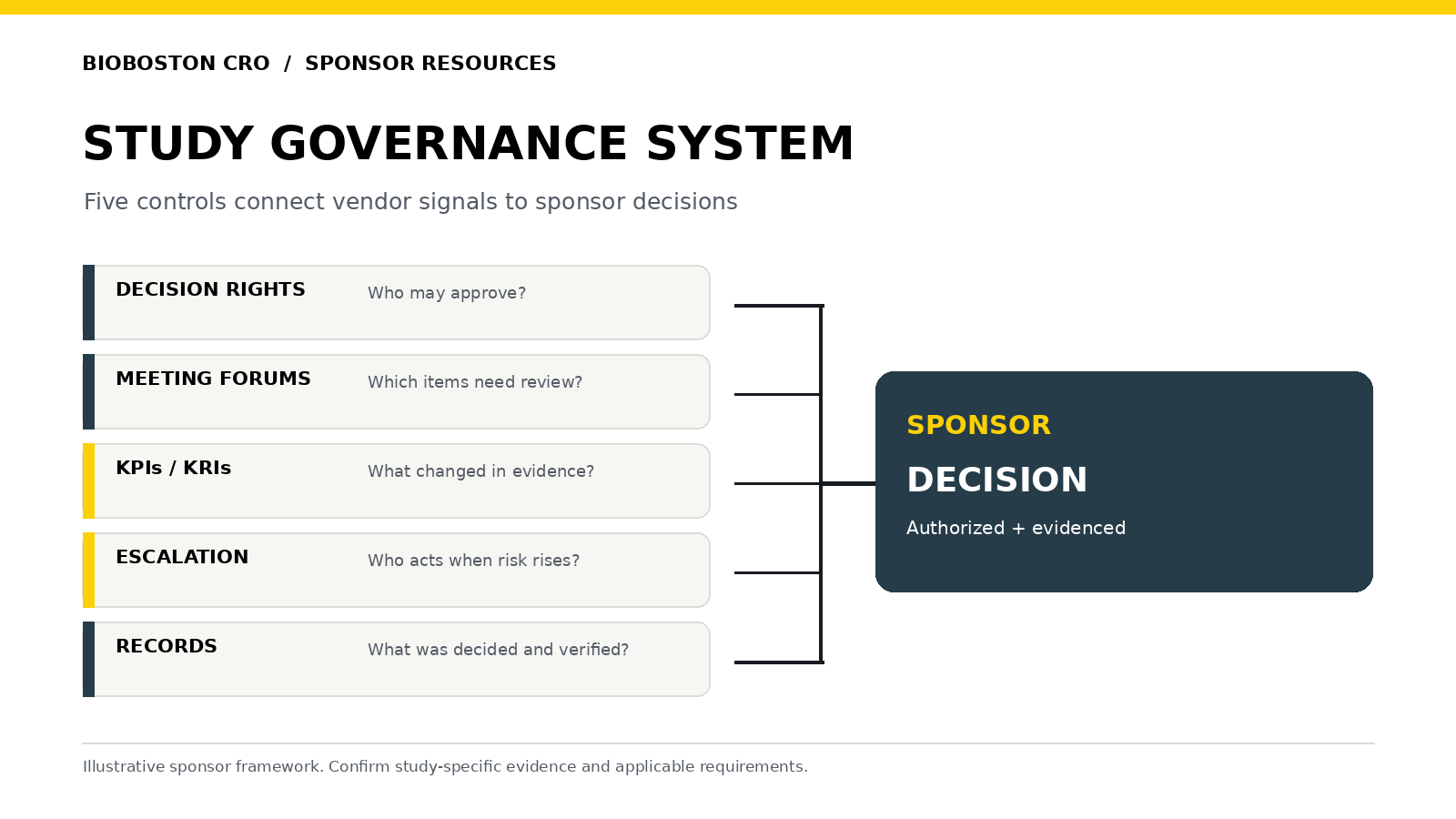
A clinical trial governance framework is the operating agreement that connects cross-vendor performance information to authorized sponsor decisions. It defines which forum decides what, which evidence each decision requires, when an issue leaves routine project management, and where the approved action is recorded. A calendar of meetings is only one component. Sponsors need a control system that still works when the CRO, safety vendor, central laboratory and data provider have different reporting lines.
This sponsor framework is for Clinical Operations, Project Management, Quality, Procurement and executive leaders managing an outsourced Phase I or II program. It is especially useful when a trial is starting up with several providers or existing governance calls generate extensive slides but few resolved dependencies. It is a suggested operating model, not a universal GCP-mandated committee structure.
Put decision rights ahead of meeting invitations
Before creating a meeting series, define the scope of every delegated activity and the sponsor’s retained review or approval obligations. Name one accountable sponsor representative for each important cross-provider interface. Separate the person who supplies information from the person with authority to approve a decision. A CRO project manager may recommend resequencing sites; that is not automatically authority to change a sponsor-approved milestone, budget or protocol approach.
For applicable US IND trials, 21 CFR 312.52 governs written transfers of sponsor obligations to a CRO. Obligations not transferred in writing remain untransferred under that provision. FDA’s ICH E6(R3) September 2025 guidance, which is nonbinding, recommends appropriate sponsor oversight of important activities performed by service providers, including subcontracted activities, and access to relevant procedures and performance information. A governance framework helps make that oversight visible; it does not replace the governing regulatory requirements or safety-reporting processes.
Maintain a short decision-rights charter covering protocol/science, safety and medical escalation, data integrity, vendor scope, financial authority, timelines and quality events. Some matters will require input or approval beyond a project team. Document who can authorize, who must be consulted, and who verifies implementation. Use the current quality agreements, study plans and contracts to check for conflicting rights before kickoff.
Five connected governance controls
The model consists of a decision charter, a forum map, a small metric set, an escalation route and an evidence register. They are designed to reinforce one another. A metric without an owner cannot drive action; an escalation without authority stalls; a decision without a retained record is difficult to reconstruct after staff or vendor changes.
| Control | Sponsor should define | Minimum evidence retained | Failure signal |
|---|---|---|---|
| Decision charter | Authorities, monetary limits, safety/quality exceptions, deputies | Approved responsibility and approval matrix | CRO acts on a recommendation as though it were approval |
| Governance forums | Purpose, quorum, attendees, cadence and time-limited outputs | Agenda, decisions, action log, attendance as needed | Meetings repeat the same open decision |
| Performance intelligence | Few KPIs/KRIs, data sources, cut-off dates and trigger logic | Dated source extracts, explanations, trend and owner | Green summary conflicts with underlying records |
| Escalation architecture | Severity, safety pathways, response owner, backup, sponsor notification | Issue ID, escalation time, response, verification | Critical issue waits for weekly governance call |
| Evidence and change history | Record locations, version control, approval/closure criteria | Accepted decision log, rebaseline/change records | No one can reconstruct why the plan changed |
Sponsor implementation principle: ensure every red or amber item enters the same controlled issue/decision tracking route even when its original data arrives through different vendors. The route may be an approved system or existing QMS/project platform. Do not create an ungoverned second database of records just because meetings need a dashboard.
Set up three forums with distinct mandates
Operational coordination addresses near-term site, vendor, data and supply dependencies. The CRO or sponsor project manager may chair. Attendees should be the leads necessary to solve the agenda, rather than every possible functional stakeholder. The output is a small updated critical-path/issue log with owners and decision requests.
Sponsor governance or steering handles cross-functional tradeoffs: priority, scope, commercial changes, major forecast revisions, resourcing and decisions that exceed delegated authority. It should receive a concise exception-based summary rather than a line-by-line replay of operations. A decision should be entered with alternatives, impact, accountable approver, due date and required implementation verification.
Quality and safety routes operate under their applicable procedures and should remain available between governance meetings. Participant-safety concerns, reportable events, significant protocol deviations, critical data-integrity issues or urgent quality signals may require immediate escalation according to the study’s procedures and applicable law. Do not hold urgent clinical decisions until a steering committee meets. QA should have an appropriate independent path to sponsor leadership when escalation through ordinary operations is ineffective.
Choose cadence by study phase and actual risk. Early startup may need more frequent dependency reviews; a steady follow-up period may need fewer meetings. Document the trigger to temporarily increase cadence, such as a missed critical predecessor, unresolved critical safety interface, material protocol change or vendor-transition risk. Frequency alone is not evidence of effective oversight.
Make KPIs and KRIs lead to a specific decision
Use a short portfolio of measures that represents the next irreversible activities and critical-to-quality factors. Examples may include evidence-supported site activation, overdue important data reconciliations, critical monitoring action age, vendor deliverable acceptance, open high-priority quality actions, and forecast-versus-baseline milestone movement. Define numerator, denominator where relevant, source, cut-off, accountable owner and decision threshold.
A KPI often reflects achievement against an agreed deliverable; a KRI warns that a future failure or unacceptable exposure is becoming more likely. One outcome may appear in both contexts depending on how it is defined. Do not confuse a high completion percentage with readiness when remaining tasks block the next milestone. Pair a red or amber threshold with a named decision: request corrective action, hold a release, change the baseline through control, or escalate for a resource decision.
For row-level definitions and the difference between leading and lagging measures, use the CRO KPI and KRI scorecard. This governance framework explains where those signals go and who acts on them; it is not an additional generic metrics catalog.
Use one decision log across providers
A decision log should contain enough context to recreate the decision, not merely the outcome. Link each item to the underlying issue, risk, deliverable or quality record. Record the last responsible decision date when a choice has schedule consequences. Clearly distinguish proposed, approved, rejected, superseded and implemented states; do not report a decision as closed until an accountable reviewer verifies its effect.
| Decision-log field | How to use it |
|---|---|
| Decision ID and issue link | Unique identifier tied to source evidence and affected milestone |
| Alternatives and recommendation | Options, risk/benefit, cost and consequences of no action |
| Authority and deadline | Named sponsor approver, approval route, last responsible date |
| Approval and effective version | Actual decision, approver, date and controlled plan reference |
| Downstream handoffs | Every affected CRO/vendor workstream and owner acknowledgment |
| Verification and closure | Objective evidence that authorized change was implemented |
A good log should allow a new sponsor project leader to distinguish what was recommended from what was approved. Meeting minutes alone can be inadequate when they do not name the approval authority, the version of the plan accepted, or the conditions attached. Store the records in the sponsor-controlled or contractually accessible essential-record architecture as appropriate.
Build the escalation ladder around impact
Agree illustrative classifications such as routine delivery, material milestone/budget impact, and critical safety, quality or data concern. Define the routes and communication response clocks before problems occur, and identify out-of-hours coverage where needed. These are project-specific governance decisions; FDA E6(R3) does not prescribe a universal four-hour or 24-hour vendor-escalation clock.
For routine delivery issues, the workstream owner can propose correction and the sponsor clinical project lead can monitor closure. For material scope, cost or timeline changes, send decision options to the person with the required authority and protect against accidental spending commitments. For a critical participant-safety or data-integrity concern, activate the applicable safety/quality process immediately, independent of the normal governance ladder. Link the urgent record back to the general issue log only after the proper path has been followed.
Revisit escalation rules after significant protocol changes, new subcontractors, safety-signal developments or changes in sponsor resources. A one-time governance charter that no longer reflects the study is a false control.
Hypothetical cross-vendor decision: the lab is not ready
Imagine a small sponsor planning first patient in in six weeks. The CRO reports site initiation visits as on track. The laboratory, however, has not approved its sample-reconciliation interface with EDC, and the supply provider has scheduled kit shipment around a forecast activation date. Each provider reports a green local workstream; the integrated milestone is threatened.
An effective governance model opens one cross-provider issue with laboratory/data acceptance evidence and a critical-path impact assessment. Operational coordination identifies options such as resequencing unaffected sites or revising the integration test plan. Sponsor steering selects the authorized response after Medical, Data Management and Finance review any downstream effect. The decision log names approving authority, revised forecast, actions and closure evidence. The scenario is hypothetical, not a BioBoston CRO completed project or typical performance result.
Field-by-field setup for a lean sponsor
Start with one sponsor decision-rights page and an agreed RACI or responsibility map. Use a single source-of-truth project plan with links to risk, issue, quality and decision registers. Define two reporting cut-offs: the operational evidence date and the steering package freeze date. Ensure there is a route to correct stale data, but do not silently rewrite historical snapshots.
Nominate a project/governance coordinator, an executive sponsor for material tradeoffs, QA access for quality matters, and appropriate Medical/Safety, Regulatory, Data Management and Finance reviewers. On a lean team, one person may wear more than one role, provided actual capability, independence needs and conflicting authorities are addressed. Backup approvers matter: an escalation route that only works when one executive is available is fragile.
For the first month, audit the decision latency rather than counting meetings: how long did a material item remain without an authorized answer, and what milestone was exposed? Also examine whether a selected set of accepted decisions can be traced from original signal through approval and vendor implementation. Improve the governance routes where that chain breaks. Do not manufacture precision from missing timestamps.
Quick launch checklist
Before claiming the framework is operating, verify the decision-rights charter is approved; forum roles and cadence are known; urgent safety/quality pathways are tested; critical interfaces have named owners; source data and reporting cut-offs are defined; material decisions are logged with approval states; and the sponsor can retrieve representative evidence. Recheck those conditions after a major vendor, protocol, systems or organization change.
BioBoston CRO’s Vendor Governance services can support governance design, cross-provider decision controls and practical oversight reporting. Explore Vendor Governance support to build a fit-for-purpose model for your outsourced trial.
Regulatory distinction: 21 CFR 312.52 governs written CRO transfers where applicable. FDA’s September 2025 ICH E6(R3) is nonbinding guidance on appropriate sponsor oversight and service-provider selection. Meeting frequencies, response clocks and decision registers in this resource are recommended sponsor operating controls, not universal regulatory obligations. Recommended reviewers: senior Clinical Operations/Project Management expert with Clinical QA, Medical/Safety, Data Management and Finance participation. Update when contracts, subcontractors, study risk or governing requirements change and at least annually.