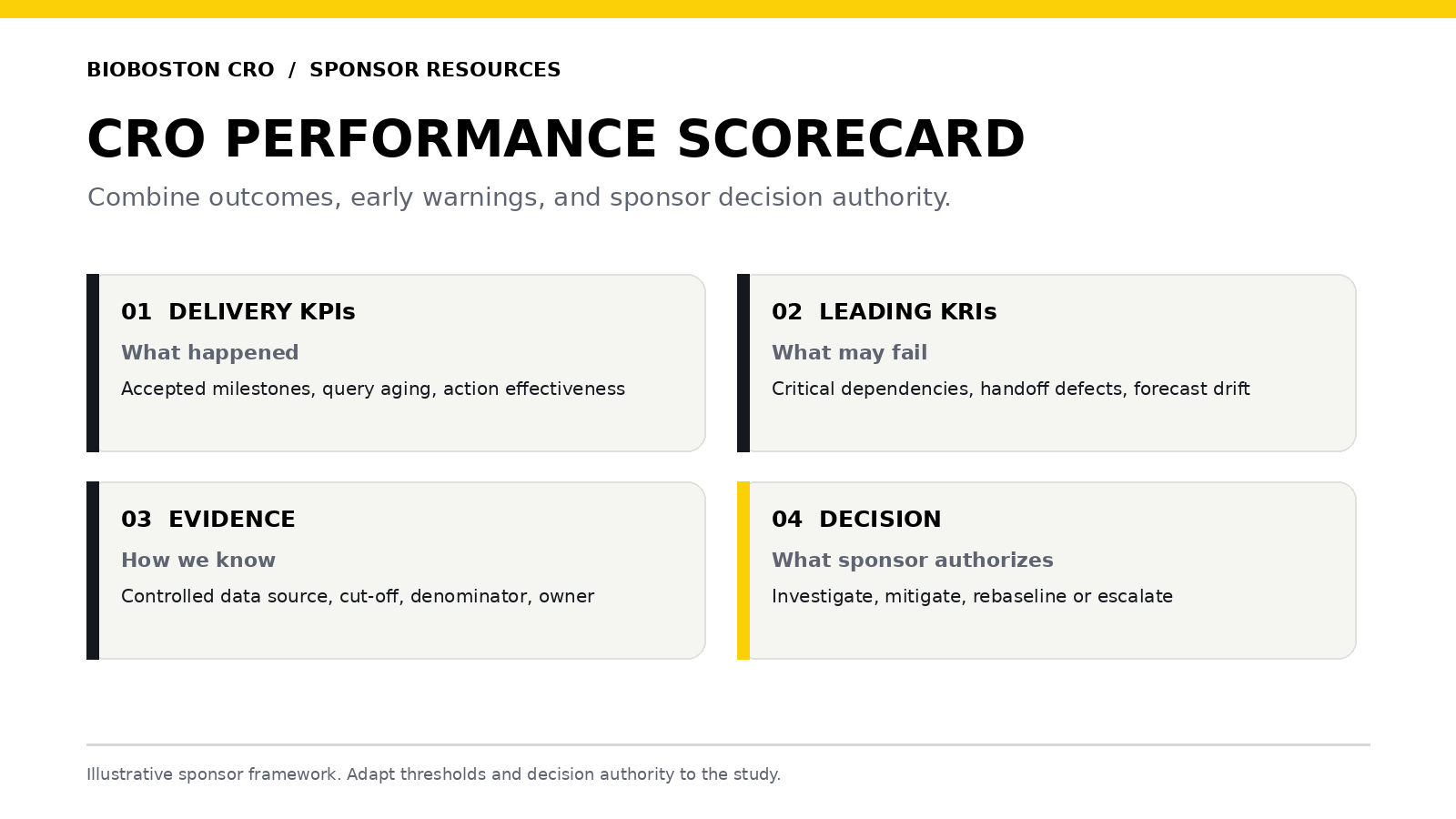
A CRO KPI scorecard should help a sponsor decide whether outsourced clinical-trial delivery remains credible, where performance is deteriorating, and which person can authorize the response. The most useful scorecard combines a small number of performance measures (KPIs) with forward-looking risk indicators (KRIs), links each number to verifiable evidence, and records an owner, threshold, trend and next decision. It is not a substitute for a risk register or urgent safety escalation.
Who should use this CRO KPI scorecard?
This template is intended for Clinical Operations, Clinical Project Management, Quality, Procurement and executive sponsors overseeing a CRO alongside laboratories, data platforms, imaging providers or specialist vendors. It is especially useful for a lean biotech team where different suppliers each report green dashboards while the combined path to first patient in, interim analysis or database lock is deteriorating.
Use it at contract mobilization to agree what the numbers mean; during routine performance reviews to evaluate trends; and when a major milestone is threatened to choose between mitigation, revised scope, formal remediation or a documented management decision. Use study-specific thresholds rather than copying numerical targets from another protocol, vendor contract or phase of development.
KPI versus KRI: measure delivery and predict trouble
A key performance indicator (KPI) describes what has happened relative to an agreed delivery or quality objective. Examples are timely issue closure, completion of required training before assigned tasks, or achievement of a contracted milestone supported by acceptance evidence.
A key risk indicator (KRI) flags an emerging threat before the final result fails. Examples include a growing count of untested critical EDC changes, unresolved vendor-to-vendor dependencies, or site-activation forecasts slipping despite favorable historical on-time rates. A KRI is useful only if the team has defined what event triggers review and what action the sponsor can take.
A red KRI does not automatically establish a GCP breach. A green KPI does not overrule an unresolved participant-safety or data-integrity event. Keep such issues in their designated processes and cross-reference the sponsor decision record.
Copyable CRO KPI and KRI scorecard
The table is a starter metric dictionary, not an industry-standard target set. Sponsors should select indicators relevant to critical-to-quality factors, contractual deliverables, and actual sources of evidence. An indicator without a denominator, a timestamp or an accountable verifier is not decision-ready.
| Indicator | Type | Definition and evidence source | Sponsor decision trigger |
|---|---|---|---|
| Milestones accepted on time | KPI | Accepted deliverables by agreed due date / deliverables due; signed acceptance record | Reforecast when critical-path deliverable is late or acceptance is disputed |
| Open critical dependencies | KRI | Count and age of unresolved predecessors to next critical milestone; integrated plan | Sponsor decision when a dependency breaches its last responsible decision date |
| Site-activation forecast reliability | KRI | Forecast-versus-actual dates with reasons; site and approval trackers | Review optimism bias when successive forecasts move without new evidence |
| Data queries past agreed aging limit | KPI/KRI | Open queries beyond study-defined age / eligible open queries; EDC reports | Examine impact on analysis milestones and source-data verification |
| High-severity quality events unresolved | KRI | Confirmed quality issue register with severity and investigation stage | Immediate pathway per issue severity; do not wait for the monthly scorecard |
| Subcontractor handoff failures | KRI | Missed receipt/acceptance events at CRO–lab–technology interfaces | Assign a single integrated owner and confirm contractual boundary |
| Approved versus forecast vendor cost | KPI/KRI | Committed and forecast cost versus approved scope; finance and change log | Seek budget authority before authorizing new work or revised scope |
| Action effectiveness | KPI | Verified effective remediations / remediations due for check; CAPA or action log | Escalate repeated failure even if actions were marked administratively closed |
Make every metric reproducible
For each row, record: metric ID; study/vendor; objective; numerator and denominator; inclusion and exclusion rules; authoritative system; reporting cut-off; baseline; current value; 3-period trend; proposed threshold; verifier; accountable sponsor owner; open decision; due date; linked issue or risk ID. If any of these are missing, mark the indicator as provisional rather than quietly labeling it green.
Define scope carefully. For example, “90% of sites active” means little without a clear denominator. Was the denominator all contracted sites, approved sites, or sites expected to activate that month? A site awaiting ethics approval must not be counted as activated merely because its training is done. For vendor metrics, agree whether weekends, country holidays, data-lag, and sponsor-caused dependencies are included.
Build thresholds from criticality, not arbitrary traffic lights
A practical scorecard has three dimensions: severity of the impact, time remaining until a decision becomes irreversible, and strength of the evidence supporting a forecast. A single fixed percentage can hide a critical exception. One overdue laboratory setup needed for first patient in may matter more than ten late administrative updates.
As an illustrative internal convention, mark Green when a milestone is evidence-supported and there is no material unresolved predecessor, Amber when credible threats require a dated intervention, and Red when a critical commitment is already missed or a sponsor-authorized decision cannot wait. Those are proposed governance labels, not regulatory categories or universal thresholds. Define numeric targets and notification expectations in the approved project plan, applicable SOP and contract.
Use two triggers for each important metric: a trend trigger (for example, deterioration in two consecutive reporting periods) and a hard stop (for example, a required approval, system release, or safety control absent before a restricted activity). The first prompts investigation; the second routes through the relevant approval or escalation process, regardless of the composite score.
How to run a weekly sponsor scorecard review
Before the meeting, reconcile CRO, laboratory, EDC and finance reports to one reporting cut-off. Investigate conflicting dates and ask the owner for source evidence; avoid converting a vendor’s self-assessment into a sponsor acceptance. Pre-read materials should identify changes since the last cut-off, not bury them in an unprioritized slide deck.
At the meeting, begin with participant-safety or critical data-integrity issues that have already been escalated through proper channels. Review the next critical milestone, cross-vendor dependencies, newly red or deteriorating indicators and executive decisions due. Separate what the service provider can correct under the agreement from what requires sponsor approval, a scope change or additional budget.
After the meeting, record a short decision log with ID, alternatives, approving authority, cost/timeline/quality consequence, due date and verification evidence. Freeze the reporting snapshot. The next report should show whether the action changed the underlying condition, not simply whether an action ticket was closed.
Hypothetical example: a green CRO dashboard hides an FPI risk
Assume a hypothetical Phase I program with first patient in scheduled in six weeks. The CRO reports 92% on-time deliverables, so its KPI remains Green against a contractually agreed 90% target. However, the central laboratory cannot confirm sample logistics, two sites still lack approval evidence, and the EDC release date has moved twice. A sponsor-side KRI register marks the integrated FPI critical path Amber or Red depending on the decision deadlines, even though the CRO’s historical KPI remains Green.
The correct sponsor decision is to request documented predecessor dates, a recovery option with trade-offs and a single named owner for the CRO–lab–EDC handoffs. If an option requires incremental spend or a protocol amendment, the decision log routes it to the appropriate authority. The sponsor does not claim FPI confidence until the prerequisite evidence supports that conclusion. This scenario is illustrative, not a BioBoston project or an observed result.
Separate contractual accountability from sponsor oversight
In applicable US IND studies, 21 CFR 312.52 requires any transfer of sponsor regulatory obligations to a CRO to be described in writing. Obligations not described are deemed not transferred; a CRO that assumes obligations must comply with the relevant requirements. FDA’s September 2025 ICH E6(R3) GCP guidance offers nonbinding recommendations for appropriate service-provider selection, access to performance information, and oversight of important transferred activities, including subcontracted activities.
That distinction matters when the scorecard finds poor performance. A sponsor’s governance dashboard can monitor activity without rewriting a contractual transfer or replacing a required safety-reporting route. Check the actual agreement, protocol, quality documents, applicable regulations and jurisdiction before labeling a responsibility or initiating corrective actions.
Common scorecard errors and how to correct them
- Counting completion without acceptance: distinguish a deliverable submitted by the vendor from one reviewed and accepted under the agreement. Show both dates where necessary.
- Comparing unlike sites or vendors: stratify by country, site cohort, service level or phase; do not reward easy cases while hiding difficult ones.
- Mixing leading and lagging indicators: display outcome KPIs beside their relevant KRIs so leadership can act before an outcome fails.
- Single-owner gaps: vendor leads can supply evidence, but a sponsor lead should own decisions that cross contracts or affect study strategy.
- Thresholds changed mid-cycle: retain the prior definition and approval record; disclose any re-baseline or scope change alongside trend comparisons.
- Quality event buried in an average: explicitly state critical exceptions; the overall score cannot cancel immediate participant protection or data-integrity obligations.
A practical 30-day implementation sequence
Days 1–5: inventory contracts, transfer documents, study milestones and evidence systems; identify the five to eight decisions leadership needs to make. Days 6–12: write metric definitions, source owners, refresh cadence and severity rules; test the denominator with real records. Days 13–20: run a shadow scorecard and reconcile conflicting vendor narratives. Days 21–30: agree action triggers and decision authorities, capture the first signed-off baseline, then review whether each metric changed a sponsor decision. This sequence is illustrative and should be adapted to study risk and available capacity.
For a broader plan covering responsibilities, handoffs and service-provider reviews, see the Clinical Trial Vendor Governance Plan Template. Where the need is multi-vendor coordination rather than another reporting dashboard, BioBoston CRO Vendor Governance describes the relevant support model.
Sponsor decision checklist
Before approving the next reporting period, ask: Is each red or deteriorating indicator supported by dated evidence? Does the sponsor know who owns the next irreversible decision? Are critical cross-vendor interfaces measured? Are quality events routed outside routine reporting when required? Have budget and scope changes received authorization? Is the next review anchored to a trigger rather than a vague promise to improve?
Need decision-ready performance oversight across your vendors? Explore BioBoston CRO Vendor Governance support to align metric definitions, escalation rules and accountable owners with your study.
Editorial note: This reusable framework is a sponsor planning aid, not a universal regulatory checklist. Recommended reviewer: senior Clinical Operations/Project Management specialist, with QA, Data Management and Finance input as applicable. Review at least annually, after changes to FDA/ICH guidance or contractual scope, and when recurring oversight decisions expose gaps.