A vendor escalation matrix tells a clinical trial team exactly when a supplier issue stops being routine, who must be informed, what response is needed, and which sponsor authority can decide the next step. The matrix works only when its severity criteria, response clocks, backups, evidence requirements and urgent safety pathways are agreed before a problem occurs. Use the framework below as a configurable sponsor tool, not as a universal regulatory timetable.
Who should use the clinical vendor escalation matrix?
Clinical Operations, Project Management, QA, Data Management and Procurement can use this matrix when a sponsor depends on a CRO, central laboratory, EDC provider, imaging vendor, depots or specialist service providers. It is most important around interfaces: one vendor’s unresolved problem may delay another’s work even while each reports its own contractual metrics as acceptable.
Apply the matrix before vendor kickoff, when revising the governance plan, after a protocol amendment, and whenever a recurring defect exposes an unclear decision route. It should complement the approved issue log, risk process, serious-event reporting, quality procedures and contract obligations—not override them. If the issue may affect participants or critical trial data, the responsible medical, safety or quality personnel must apply their required immediate processes in parallel.
Four separate clocks prevent escalation confusion
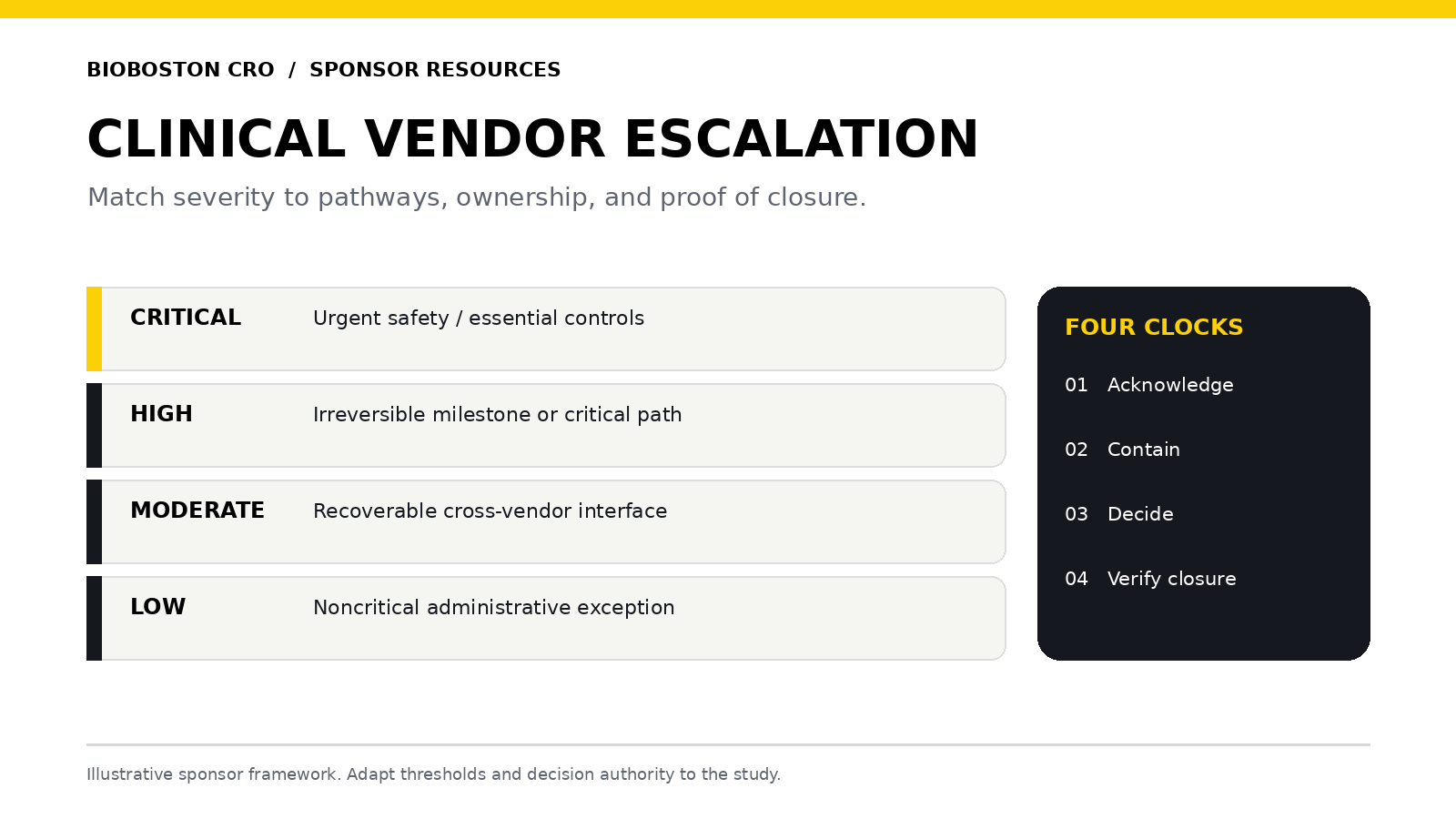
A common failure is treating all response times as one service-level agreement. Define acknowledgment (the notified person confirms receipt), containment (risk is stabilized while work continues safely), decision (an authorized sponsor action or approved alternative is chosen), and resolution/effectiveness (the root problem is corrected and objective evidence supports closure). Each clock can have a different owner and agreed target.
For example, a CRO may acknowledge an urgent issue promptly but lack the authority to approve a new laboratory or release a critical system. Conversely, a sponsor may approve a mitigation but still require the vendor to demonstrate that the fix worked. Do not mark a matter closed when only an acknowledgment or recommendation exists.
Copyable clinical vendor escalation matrix
The response targets below are illustrative internal planning examples only. They are not statutory deadlines, universal industry SLAs or substitutes for protocol-specific notification requirements. Actual timelines must come from applicable regulations, safety procedures, contract schedules, working hours, time-zone coverage and the nature of the event. In particular, serious safety and data-integrity situations may require immediate action under separate procedures.
| Severity / class | Example trigger and effect | First responder and escalation | Example governance clock |
|---|---|---|---|
| Critical / safety or essential control | Potential participant harm, serious integrity concern, or prohibited activity before required approval | Initiate applicable urgent medical/QA/safety process; notify authorized sponsor lead and relevant vendor leadership | Immediate pathway; record actual times and required statutory/protocol notifications separately |
| High / critical-path threat | Required lab, EDC or site-release evidence missing before an irreversible milestone | Vendor operational lead plus sponsor Clinical Operations; escalate to program decision authority and QA as needed | Acknowledge promptly; same-day sponsor decision checkpoint where feasible |
| Moderate / recoverable interface issue | Repeat late data transfers or reconciliation backlog threatens forecast but has an approved workaround | Vendor leads, cross-vendor interface owner and sponsor PM | Agreed working-day acknowledgment; dated mitigation and trend review |
| Low / administrative exception | Documentation reformatting or noncritical variance without near-term CTQ impact | Designated service owner and sponsor coordinator | Routine agreed review cycle with closure evidence |
Critical-to-quality (CTQ) refers here to factors that matter materially to participant protection or reliability of trial results. Assign categories through the study’s actual risk-assessment process. Do not downgrade a critical safety or quality concern because the vendor promises recovery by the next reporting call.
Add ownership, contact and evidence fields
For each class, document the trigger, service agreement reference, primary vendor contact, vendor backup, sponsor accountable owner, sponsor backup, on-call route, available hours/time zone, decision authority, notification list, escalation destination, timestamp rule, response target, containment evidence, resolution evidence and closure verifier. Maintain contact details in a controlled directory rather than exposing phone numbers in public templates.
Where multiple vendors are involved, name one interface owner who verifies the handoff from origin to acceptance. A central lab sending a status file is not the same as the EDC provider successfully receiving and validating it. Record the sender’s release ID, receiver’s acceptance confirmation, reconciled exception list, and any impact on a downstream milestone. An ownership diagram alone cannot prove a transfer was successful.
Use a backup role, not a single individual with no holiday coverage. Include the trigger for bypassing a non-responsive first contact. The matrix should work on a Friday evening, during a public holiday, and when the person named in the contract is unavailable.
Define escalation thresholds by event, not arbitrary color
A measurable trigger has an observable fact, a source of record, an impact test and a decision deadline. “Vendor slow” is not actionable; “two consecutive critical lab files missing acceptance evidence at the agreed daily cut-off” is actionable when the team can show the timestamps and what it threatens.
Examples of configurable triggers: A missed critical validation or release date; a suspected breach of blinding; repeated data-transfer failures; unresolved site training before assigned trial tasks; a forecast that exceeds the last date at which mitigation is still viable; a subcontractor change without required prior approval; or a dispute over a contract-bound deliverable that cannot be resolved within the normal coordination tier.
Not every trigger should use the same numerical threshold. A minor reporting delay may be handled on the weekly call; an approval gap blocking first participant activities needs the relevant stop/approval process at once. For each trigger, state what the team must not do until appropriate evidence or authorization exists.
Escalation flow: from evidence to an approved decision
1. Detect and classify. Log the event with timestamp, source system, affected study/site/data and provisional severity. Confirm what is known versus unverified. If urgent, activate dedicated safety or quality pathways immediately.
2. Contain and assign. Assign a responsible operational owner and sponsor accountable person. Prevent restricted or unsafe activities as required. Determine whether the problem spans vendors and whether a backup contact is needed.
3. Verify the decision boundary. Compare the proposed action with the transfer-of-obligations writing, contract and sponsor delegation. A vendor can recommend a replacement workflow; only an authorized party can approve changes that require sponsor, investigator, ethics, regulatory or budget authorization.
4. Escalate options, not just bad news. Supply the decision maker with the evidence, effect on critical milestones, participant/data impact, options, cost, residual risks, and latest safe decision date. Record when the option was received and decided.
5. Verify the result. Confirm containment, corrective implementation and effectiveness against objective evidence. Update the issue/risk record and next forecast, and archive the decision trail. Repeat failures may justify a systemic investigation or a stronger vendor oversight response.
Hypothetical case: laboratory interface threatens database lock
Consider an illustrative Phase I study preparing for database lock. The central lab reports that a final data extract was sent. The EDC vendor says it was rejected because the mapping version did not match the approved specification. The CRO’s milestone dashboard remains green because the transfer task is marked “complete.” The sponsor interface owner instead classifies the event as a High critical-path threat, supported by rejected-file evidence and the lock schedule.
The interface owner asks the laboratory for a corrected file and the EDC team for acceptance-test evidence, while the sponsor Data Management lead confirms whether the proposed recovery path protects data traceability and validation controls. If the fix would change scope or affect a controlled data-management plan, the authorized sponsor decision maker is engaged before implementation. The event is downgraded only after the receiving system confirms the correct file is accepted and the downstream timeline is re-evaluated. This case is hypothetical and does not describe BioBoston client work.
Align escalation with binding obligations and nonbinding guidance
For an applicable US drug trial under an IND, 21 CFR 312.52 requires sponsor obligations transferred to a CRO to be specified in writing; an obligation not covered is deemed not transferred. FDA’s September 2025 ICH E6(R3) Good Clinical Practice guidance contains nonbinding recommendations about service-provider suitability, agreements, access to oversight information, important outsourced activities and appropriate quality management.
Neither source prescribes the exact four-level matrix or numerical response clocks above. Moreover, urgent regulatory reporting and participant protections may have their own binding rules. Sponsors must verify applicable jurisdiction, product type, protocol, agreements, clinical safety procedures, and incident classification rather than substituting this sample matrix for them.
Five controls that keep escalation credible
One evidence cut-off: distinguish the date of detection, notification, acknowledgment, containment and sponsor decision. Avoid overwriting original times. One responsible owner per step: contributors may be many, but accountability for the end-to-end handoff should be clear. One approved communication route: avoid unauthorized redistribution of sensitive participant details. One version-controlled matrix: record changes in thresholds or contacts. One closure test: a vendor saying “fixed” does not equal verified effectiveness.
The matrix should also define when to include Procurement or Legal, when the issue may create a change order or dispute, and what must go to senior leadership. Preserve these routes without allowing commercial discussions to impede critical safety or quality action.
Review and test the escalation matrix
At startup, use a short tabletop exercise: the laboratory contact is unavailable, a critical EDC extract fails after business hours, and a change order is needed to reroute activities. Ask participants to name the first contact, backup, sponsor authority, evidence required, communication channel and safe decision deadline. If any answer depends on personal memory, update the matrix and controlled directory.
After each material incident, compare actual acknowledgment, containment, decision and verification times against the agreed process. Identify whether the delay arose from missing evidence, absent contact coverage, unclear authority, incompatible systems or a contract gap. Correct the underlying weakness and test the revised route.
For a full operating model that includes routine accountability and performance reviews, refer to the Clinical Trial Vendor Governance Plan Template. When escalation exposes interface ownership gaps, BioBoston CRO Vendor Governance services provide a relevant path for discussion.
Sponsor sign-off checklist
Before this matrix goes live, verify: Does every severity level have an observable trigger? Are safety/quality routes explicitly protected? Are contacts and backups current? Are the four response clocks separate? Is the sponsor approver identified for cost, protocol and timeline changes? Does closure require receiver-side evidence? Are subcontractor and cross-vendor interfaces covered?
Need to replace informal escalation with an accountable sponsor process? Explore BioBoston CRO Vendor Governance support to define thresholds, decision rights and evidence-based handoffs across suppliers.
Editorial note: Sample response times and severity classes are operational examples only. Recommended reviewer: senior Clinical Operations/Project Management with QA, Clinical Safety and Data Management input. Reassess after critical incidents, vendor changes, contract amendments, or updates to applicable guidance.