A vendor governance meeting agenda should lead to documented sponsor decisions, not a replay of every vendor’s activity report. In a multi-vendor clinical trial, the meeting should examine shared milestones, unresolved handoffs, changes in risk and cost, and items requiring approval. Use the agenda below with a decision log that identifies exactly who is authorized to act, what evidence supports the choice, and when the outcome will be verified.
Who needs this meeting format?
This template is designed for Clinical Operations, Project Management, Quality, Procurement and study executives overseeing a primary CRO plus laboratories, EDC/eCOA providers, imaging vendors, central randomization or other specialist providers. It is especially valuable when each supplier has a separate workplan and no one is clearly accountable for the combined delivery path.
A one-to-one CRO governance meeting may already exist. The value of this cross-vendor format is different: it resolves interface ownership and decisions that individual service providers cannot settle alone. A vendor can report progress, but only the sponsor’s authorized decision maker can approve a material change to study strategy, additional cost or a revised milestone when required by the governance arrangements.
Define the forum and its authority before scheduling
Write down the meeting charter: which studies and contracts are covered; who chairs; required participants and backups; frequency; evidence cut-off; who may make which decisions; how urgent topics are handled between meetings; and where controlled outputs reside. Separate operational coordination, formal quality escalation, and executive steering. The meeting should not become an alternative route that delays urgent participant-safety or data-integrity action.
Keep the decision rights explicit. The sponsor Clinical Operations lead may coordinate operations, the QA lead may advise on quality impact, the finance or procurement lead may validate the commercial mechanism, and the designated sponsor executive may authorize scope or budget changes. The particular approval chain follows the sponsor’s delegation and contracts; these titles are examples, not mandatory positions.
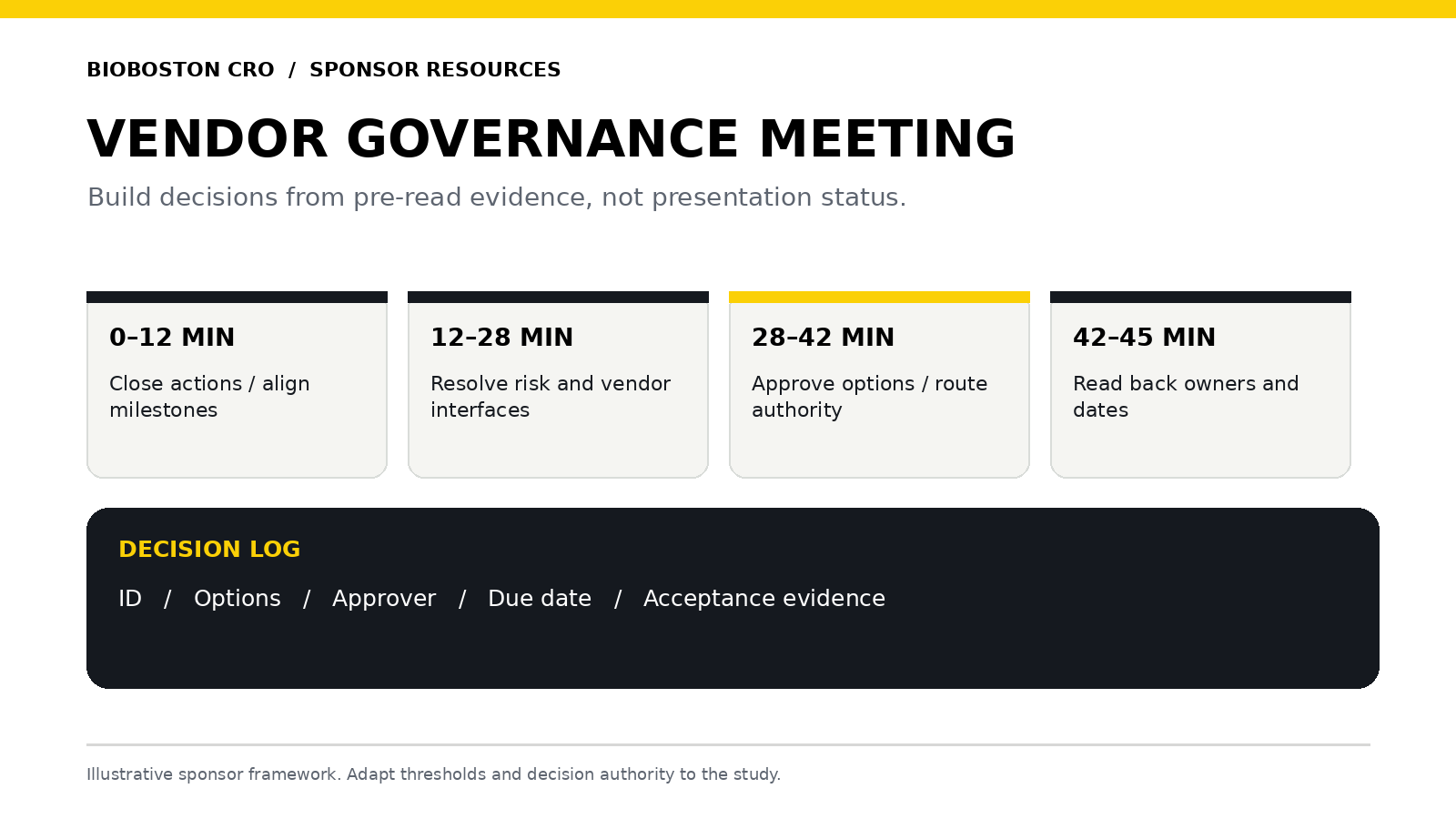
Copyable 45-minute vendor governance meeting agenda
Distribute a short evidence pack before the call. The agenda assumes an ordinary operational review. Urgent incidents use the appropriate immediate process rather than waiting for this forum. Adjust the allotted time based on risk and the number of vendors.
| Minute | Agenda item | Pre-read evidence | Required output |
|---|---|---|---|
| 0–5 | Prior decisions and open critical actions | Last decision log; closure evidence | Accept closure or re-open with reason |
| 5–12 | Critical-path milestones and handoffs | Integrated plan; approval/release dates | One forecast and named cross-vendor owner |
| 12–20 | Leading quality/data/operational signals | Issue register; KRI trend; exceptions | Risk action or escalation routing |
| 20–28 | CRO–lab–technology interface failures | Transfer receipts; open defect and sample logs | Interface owner, root-cause action, checkpoint |
| 28–35 | Contract, scope and budget changes | Change requests; commitments; forecasts | Authorized decision or approval route |
| 35–42 | Decision queue and unresolved disputes | Options paper; due dates; dependencies | Decision ID, approver and deadline |
| 42–45 | Read-back and next evidence check | Updated action list | Confirm owners, due dates and circulation |
A 45-minute agenda is a facilitation example, not an FDA or ICH requirement. If the decision queue is larger than the slot, hold a targeted follow-up with people who have actual approval authority. Do not consume the entire meeting presenting green metrics; circulate them by exception.
The decision log: fields sponsors can copy
Each decision record should have a stable ID and link to the underlying issue, risk, contract or plan. It must distinguish an approved decision, an unapproved recommendation, and an action to gather more evidence. Those states have different legal and operational consequences.
| Field | What to enter | QA question |
|---|---|---|
| Decision ID and date | Unique ID, meeting/date, study and affected vendors | Can it be traced across systems? |
| Decision requested | One precise choice and decision deadline | What happens if no one decides? |
| Options and consequences | Feasible alternatives; timing, cost, quality and participant impact | Are material disadvantages visible? |
| Evidence and assumptions | Versioned plan, vendor report, approval or quality record | Is any input unverified or out of date? |
| Recommender and approver | Person proposing; authority who can accept | Is advice being mistaken for authorization? |
| Decision status | Proposed, awaiting approval, approved, rejected or deferred | Is the status backed by recorded approval? |
| Implementation owner | Named person accountable for execution | Does the owner control the work? |
| Due date and verification | Delivery date, acceptance criteria, evidence location | Who confirms the decision worked? |
Example record: hypothetical laboratory handoff
D-021 (illustrative): A central laboratory cannot confirm readiness for sample pickup at two activation sites. Options are (A) shift activation sequence without changing the protocol or (B) implement a temporary approved logistics arrangement after sponsor and quality review. Clinical Operations recommends option A, contingent on confirmed site capacity and supply availability. The sponsor decision maker has not approved either option. Status therefore remains awaiting approval; the CRO project manager is assigned to obtain revised site dates; the laboratory owner must provide documented logistics evidence by the next decision checkpoint. This is a fictional illustration, not a client result.
The record should not say “approved to proceed” until the authorized person acts. If the change affects informed consent, protocol activities, investigational-product handling or participant safety, the applicable regulatory, medical and quality routes must also be consulted. The governance call cannot supersede them.
Distinguish decisions, actions, risks and issues
A decision grants or declines authorized direction; an action tasks somebody to produce work or evidence; an issue is a condition already present; a risk is a possible future event. Mixing all four in a single status field makes open items disappear. Use separate identifiers, then cross-reference them.
Example: a delayed EDC release is an issue; projected impact on first patient in is a risk; approval to resequence startup is a decision; and obtaining validated EDC release evidence is an action. Their owners and closure criteria may differ. An administrative “closed” action does not prove the underlying issue is resolved.
For higher-risk items, the sponsor may require a formal documented deviation, investigation or CAPA process. The decision log should reference, not replace, that controlled record. The action owner verifies delivery; the appropriate quality function verifies effectiveness where required.
What should be in the pre-read packet?
Keep the packet short enough for leadership to review. Include an updated critical path with actual and forecast dates; a limited KPI/KRI exception summary; a vendor interface log; participant-safety or data-integrity items routed through proper pathways; open decisions ranked by last responsible decision date; budget/change-order implications; and the prior meeting’s closures with evidence references.
Use a single reporting cut-off for every supplier. If CRO and laboratory files cover different reporting periods, label the mismatch; do not synthesize a confident single status from incompatible dates. Include both the vendor’s claimed completion and sponsor acceptance when those are distinct. Make sources accessible to authorized reviewers, including relevant subcontractor performance evidence where appropriate and contractually available.
Run the meeting as a decision sequence
Before: The sponsor chair asks vendors to submit exceptions and source evidence. An assigned coordinator flags deadlines and builds an integrated view of dependencies. Decision papers list options with risks and cost, rather than a recommendation without alternatives.
During: Start with prior decisions and their observable result. Prioritize unresolved critical-path dependencies. Ask for the last verified date rather than “percent complete.” When a topic needs new authority, record exactly who must approve it and by when. Resolve interface ownership explicitly: one person accountable for the end-to-end handoff, plus named contributing vendors.
After: Circulate a concise decision/action record according to the agreed governance process. Attach source references, not unnecessary personal or sensitive participant information. Confirm discrepancies, record any documented challenge to minutes, and store the final record in the sponsor-controlled location. At the next meeting, review evidence of effectiveness rather than repeating the previous status text.
How often should vendor governance meetings occur?
Choose frequency based on risk and the nearest irreversible milestone. During startup with multiple system releases and site activations, weekly coordination may be justified. A stable execution phase may support less frequent strategic oversight alongside routine operational calls. When a critical dependency changes, use a targeted escalation outside the calendar. The meeting schedule is a sponsor governance choice, subject to applicable process and contract, not a universally prescribed GCP cadence.
The routine agenda can be adapted to vendor type. For an EDC vendor, prioritize build/release and issue aging. For a laboratory, focus on kit availability, shipping, sample receipt, turnaround and reconciliation. For a CRO, integrate startup, monitoring, trial data and oversight. The common objective is to expose the connections between vendor deliverables, not to force unrelated performance indicators into one average.
Regulatory and contract context
For applicable US IND trials, 21 CFR 312.52 governs the written transfer of sponsor obligations to a CRO. FDA’s September 2025 ICH E6(R3) Good Clinical Practice guidance includes nonbinding recommendations about documenting service-provider arrangements, access to relevant performance information and appropriate oversight of important transferred activities and subcontracted work. These sources support robust governance, but they do not mandate this 45-minute agenda or this specific decision-log format.
Before implementing the forum, reconcile the governance charter with the responsibility matrix, transfer-of-obligations documentation, contract notice periods, and urgent safety/quality procedures. Avoid allowing a vendor meeting to authorize changes that only the sponsor or another designated body may approve.
Failure patterns worth preventing
- The only people present cannot decide. Separate recommendation and authorization; route budget and protocol decisions explicitly.
- The agenda is a vendor presentation. Ask for outcome evidence and decision options, not decorative slide status.
- Actions disappear after assignment. Require a verifier and closure evidence at the next checkpoint.
- Vendor A blames Vendor B. Name a sponsor-controlled cross-vendor interface owner and define each input/output acceptance point.
- Critical events wait for the next meeting. Maintain separate immediate pathways for safety, data integrity, serious quality concerns and required notifications.
- Decisions conflict with contracts. Compare action to agreed scope, notice, amendment and change-control requirements before instructing work.
For the wider operating plan, see the Clinical Trial Vendor Governance Plan Template. If decision rights, interface ownership or review routines remain unclear, BioBoston CRO Vendor Governance services may help structure the operating model.
Final five-minute chair checklist
Can the chair state every decision due before the next forum? Are approvers actually authorized? Does each cross-vendor dependency have one accountable owner? Does every critical action identify objective closure evidence? Were urgent safety and quality matters routed outside routine governance as needed? Do the minutes distinguish provisional forecasts from approved re-baselines?
Need a decision-ready vendor governance forum? Explore BioBoston CRO Vendor Governance support for meeting architecture, cross-vendor ownership and documented sponsor decisions.
Editorial note: This template is an example governance aid, not a mandated regulatory agenda. Recommended review: Clinical Operations/Project Management, with sponsor QA and Procurement/Finance input. Revisit after protocol or vendor changes, recurring decision delays, and updates to applicable guidance or contracts.