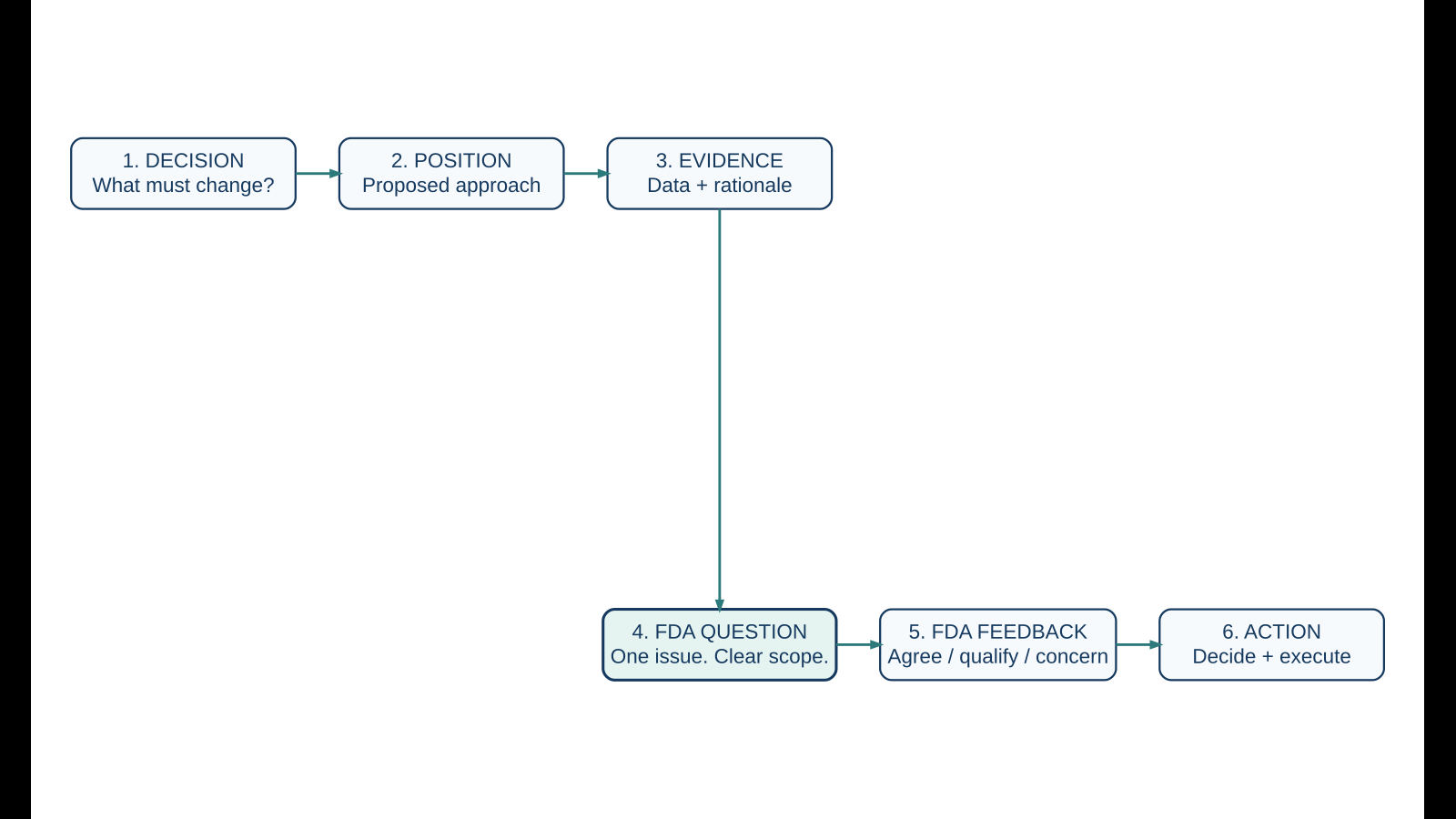
FDA meeting questions should be narrow enough for the Agency to answer, supported by enough context to understand the issue, and tied to a real sponsor decision. The strongest questions do not ask FDA to design the development program. They show the sponsor’s proposed approach, identify the specific uncertainty, and make clear what feedback is needed to move forward.
That discipline matters because the question list drives who FDA needs in the discussion, how reviewers prepare, and how efficiently the allotted meeting time can be used. A long list of broad or multipart questions can dilute the value of the interaction even when the underlying science is strong.
Quick answer: what makes FDA meeting questions useful?
A useful FDA meeting question has five characteristics: it addresses one important decision, states or implies a defined sponsor position, is supported by traceable evidence, is scoped so FDA can answer it within the meeting format, and leads to a clear next action after FDA responds.
Before polishing wording, test whether the question matters. If the answer would not change the development plan, reduce a meaningful uncertainty, or confirm an important program assumption, it may not deserve one of the limited question slots.
Who this guide is for
This guide is designed for CEOs, CMOs, Heads of Regulatory Affairs, clinical-development leaders, and cross-functional program teams preparing for a pre-IND, Type B, Type C, or other formal FDA interaction. It is especially useful when Clinical, Nonclinical, CMC, Statistics, and Regulatory teams are competing for limited space in the same meeting request or briefing package.
1. Start with the sponsor decision, not the sentence
Teams often begin by editing wording before agreeing on the decision behind the question. Reverse the sequence. First identify the program decision that is blocked or materially affected by FDA feedback. Then identify the sponsor’s preferred approach, the evidence supporting it, and the remaining uncertainty.
| Define first | What the team should be able to state | Why it matters |
|---|---|---|
| Decision | What will the sponsor decide or finalize after FDA responds? | Confirms the question has real program consequence |
| Sponsor position | What approach does the sponsor currently propose? | Prevents outsourcing the development decision to FDA |
| Evidence | What data, analysis, prior advice, or scientific rationale supports the position? | Gives FDA a reviewable basis for feedback |
| Uncertainty | What specific issue still needs Agency input? | Defines the boundary of the question |
| Next action | What changes if FDA agrees, disagrees, or qualifies the response? | Makes the question useful to the development plan |
2. Use the sponsor-side FDA question quality scorecard
Before FDA meeting questions enter the final package, score them. The goal is not to turn regulatory strategy into arithmetic. The scorecard forces the team to expose weak questions early, before they consume writing and review time.
| Criterion | 0 points | 1 point | 2 points |
|---|---|---|---|
| Decision relevance | No clear program decision | Useful but not time-critical | Directly affects a near-term development decision |
| Sponsor position | No proposed approach | Position is implied or unresolved | Clear proposed approach is stated |
| Evidence support | Little or no support | Some support but gaps remain | Relevant evidence is identified and traceable |
| Answerability | Broad, multipart, or open-ended | Mostly focused but still needs narrowing | One defined issue that can be addressed directly |
| FDA value-add | Answer is readily available in existing guidance | Some interpretation is needed | Program-specific FDA feedback materially reduces uncertainty |
Suggested interpretation: 8-10 points = strong candidate; 5-7 points = revise before finalization; 0-4 points = reframe, combine with a better question, or remove. This is a BioBoston sponsor-side prioritization tool, not an FDA requirement.
3. Write FDA meeting questions around one decision
FDA’s 2026 formal-meetings guidance recommends keeping the total question load manageable and specifically counts subquestions toward the total. That makes “one giant question with multiple clauses” a poor workaround for the question limit.
When several issues are genuinely linked, decide which one is the decision-driving uncertainty and move the supporting facts into the context section. If the issues would require different FDA disciplines, different evidence, or different sponsor actions, they are usually better handled as separate questions or prioritized against each other.
Use a simple drafting pattern
A practical question structure is:
Does FDA agree with [specific sponsor proposal], based on [defined evidence or rationale], for the purpose of [specific development decision or milestone]?
Not every question needs to use “Does FDA agree,” but the pattern is useful because it forces the sponsor to present a proposal instead of asking a broad exploratory question.
4. Rewrite broad questions into answerable questions
The examples below are hypothetical and should be adapted to the actual product, evidence, meeting type, and review division.
| Discipline | Weak question | Stronger direction |
|---|---|---|
| CMC | “Is our manufacturing strategy acceptable?” | “Does FDA agree that the proposed release-testing strategy for the Phase 1 drug product, as summarized in Section X, is adequate to support the proposed first-in-human study?” |
| Nonclinical | “Is our toxicology plan sufficient?” | “Does FDA agree that the proposed repeat-dose toxicology study in [species], together with the completed supporting studies summarized in Section X, is adequate to support initiation of the proposed first-in-human study?” |
| Clinical | “Is the Phase 1 design acceptable?” | “Does FDA agree with the proposed starting-dose and dose-escalation approach for the first-in-human study, based on the nonclinical and exposure rationale summarized in Section X?” |
| Statistics / endpoint strategy | “Are our endpoints okay?” | “Does FDA agree that [endpoint] is appropriate for the stated objective in the proposed study, given the rationale and measurement plan summarized in Section X?” |
The stronger versions are not automatically “good questions.” They still require accurate product-specific context, an internally agreed sponsor position, and evidence sufficient for FDA to understand the issue.
5. Give FDA enough context without burying the question
FDA’s final formal-meetings guidance calls for a brief explanation of the context and purpose of each question and, in the meeting package, data organized by discipline and question. The practical implication is that the background should make the question answerable, not become a second report.
For each question, include only the information needed to understand the proposal, the relevant evidence, the unresolved issue, and the consequence of the answer. If reviewers must search across unrelated sections to reconstruct the rationale, the question is not yet packaged efficiently.
If the overall package architecture is still being defined, use the companion resource on how to organize a pre-IND meeting briefing package before finalizing the question set.
6. Group questions by FDA discipline and preserve numbering
The 2026 guidance recommends grouping precise questions by FDA discipline and keeping the numbering and scope of questions in the meeting request similar to the numbering and scope used in the meeting package. That continuity matters operationally: it helps reviewers understand which expertise is needed and reduces confusion when questions are refined between the request and package.
A practical internal question register can include:
| Question ID | Discipline | Sponsor owner | Decision affected | Evidence source | Status |
|---|---|---|---|---|---|
| Q1 | CMC | CMC Lead | Clinical-entry control strategy | Current CMC summary / data cutoff | Ready / revise / hold |
| Q2 | Nonclinical | Nonclinical Lead | IND-enabling study plan | Study reports / protocol rationale | Ready / revise / hold |
| Q3 | Clinical | Clinical Lead | First-in-human design | Protocol synopsis / dose rationale | Ready / revise / hold |
7. Prioritize the questions before the final drafting cycle
Not every unresolved issue belongs in the FDA meeting. Prioritize questions where FDA feedback can materially change the next development step and where the answer is not already available through current guidance, prior Agency feedback, or an internal scientific decision.
A useful prioritization discussion asks four things: How consequential is the decision? How uncertain is the sponsor’s current position? How valuable is FDA input at this point in development? What happens if the question is deferred?
This is also where Regulatory Pathway and Submission Planning support may be useful when the uncertainty is broader than wording and requires a development or submission-sequencing decision.
8. Separate question strategy from final wording review
A medical or regulatory writer can improve precision, consistency, and readability, but the sponsor’s technical leaders must own the underlying position. Resolve scientific disagreements before the final copyediting pass. Otherwise, reviewers will keep rewriting the sentence while the real issue remains unsettled.
BioBoston CRO provides FDA Briefing Book Writing support for question refinement, package integration, cross-functional review, and independent quality control when sponsors need a controlled authoring process around the meeting strategy.
Common failure modes in FDA meeting questions
- Asking FDA to design the program instead of evaluating a sponsor proposal.
- Combining several scientific or regulatory issues into one multipart question.
- Using a broad “Is this acceptable?” question without defining what “this” includes.
- Submitting a question before the sponsor team agrees on its own position.
- Providing background that is longer than necessary but still does not answer the key “why” behind the question.
- Asking questions already addressed by current guidance without explaining the program-specific uncertainty.
- Failing to connect the question to a decision that will occur after FDA responds.
- Changing the scope or numbering late enough that the meeting request and package no longer align clearly.
FDA meeting questions: readiness checklist
Before the final question list is approved, confirm that:
- Each question addresses one defined issue.
- The sponsor has a clear proposed position or approach.
- The evidence supporting that position is identified and current.
- The context explains why FDA feedback is needed.
- The expected FDA response can reasonably be provided within the meeting format.
- The answer will change, confirm, or de-risk a real sponsor decision.
- The question is assigned to the correct FDA discipline.
- The total question set is prioritized and appropriately limited.
- The numbering and scope remain consistent from meeting request to final package.
- The final package contains enough supporting context for FDA to answer without reconstructing the issue from unrelated sections.
Need help refining questions for an FDA meeting?
Explore BioBoston CRO FDA Briefing Book Writing support for a source-supported question set and meeting package organized around defined sponsor positions, evidence, cross-functional review, and actionable FDA feedback.