RACI vs responsibility matrix is not simply a question of terminology. A RACI assigns who is Responsible, Accountable, Consulted, and Informed for a task or decision. A broader clinical trial responsibility matrix can also specify the controlling contract, process step, deliverable, evidence record, system access, handoff, escalation and approval rights. Sponsors often need both views, particularly when a CRO, sites, laboratories and technology vendors share an operational workflow.
This explainer is for Clinical Operations leaders, clinical project managers, Quality and Regulatory teams, and sponsor executives defining a multi-vendor operating model before kickoff or resolving recurring ownership conflicts.
What a RACI can and cannot do
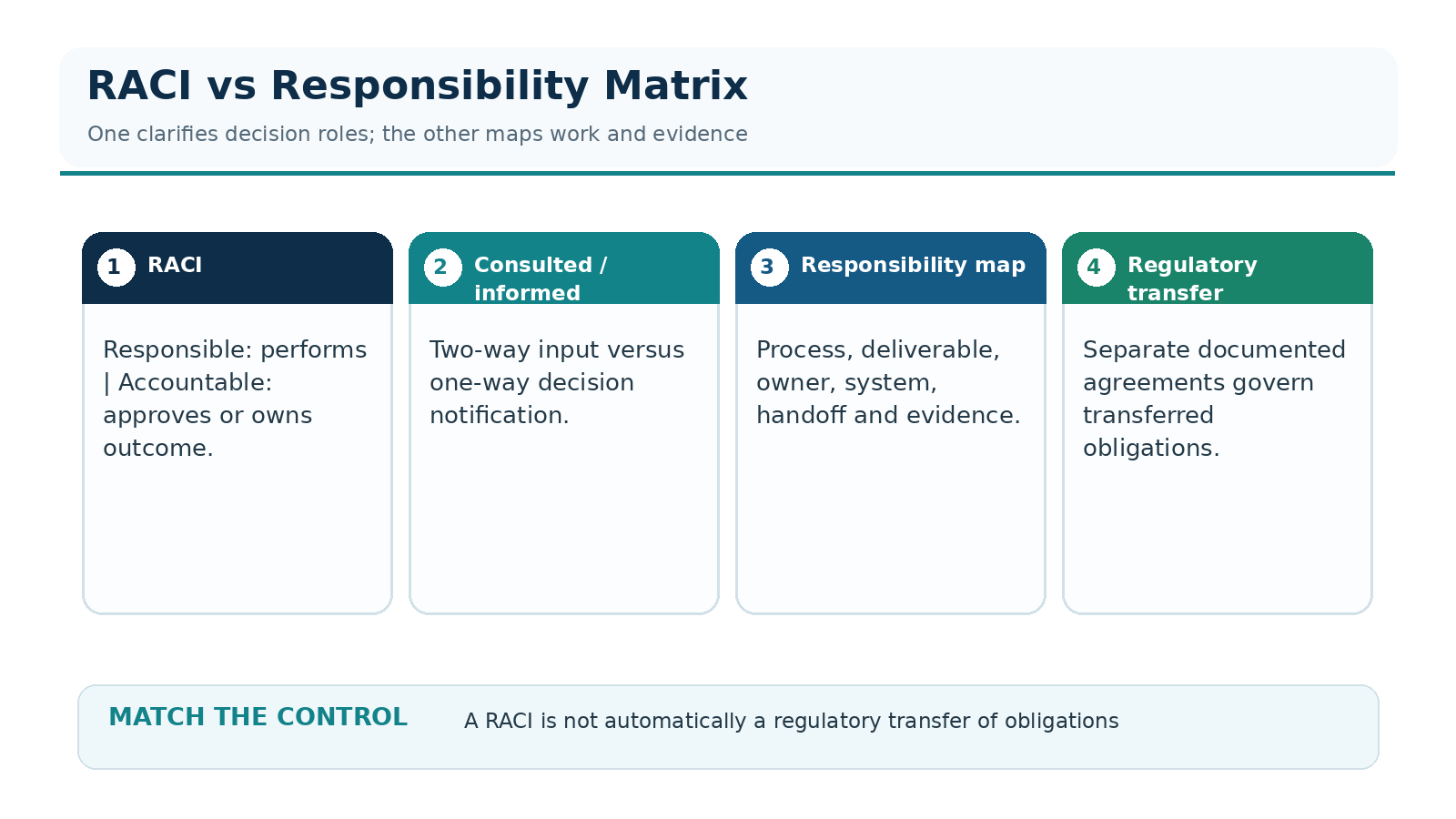
A RACI is a compact decision and communication map. Responsible indicates who performs or coordinates the work; Accountable identifies who owns the outcome or decision in that operational map; Consulted parties provide input before a decision; and Informed parties receive the decision or status. The meaning of Accountable should be documented, especially where sponsor sign-off and vendor deliverable approval differ.
A RACI alone usually does not show where the evidence lives, whether a transfer of obligations has been documented, how system permissions are granted, what happens at a vendor handoff, or who handles an exception. An expanded responsibility matrix can record those operational controls without requiring a separate spreadsheet for every interface.
RACI versus expanded responsibility matrix
| Decision dimension | Standard RACI | Expanded responsibility matrix |
|---|---|---|
| Who performs and decides? | R/A roles by activity | Named function and decision authority |
| Who must be consulted or notified? | C/I roles | Consultation timing and communication evidence |
| Which deliverable is produced? | Usually task label | Exact output, acceptance and due date |
| Which agreement applies? | Often not represented | SOW, quality agreement or transfer record reference |
| Where is the proof? | Typically not represented | Source system, record owner, version and archive |
| What happens if work fails? | May be unclear | Escalation route, exception and backup owner |
The expanded matrix need not replace the RACI. Keep the RACI readable for operations, and attach only the extra columns needed to control risk-critical interfaces.
Regulatory transfer is a separate question
For US IND work, 21 CFR 312.52 specifies that transfer of sponsor obligations to a CRO must be described in writing; obligations not included in that writing are considered not transferred. A RACI marked “CRO: A” is not by itself proof that a regulatory obligation was transferred. The exact legal/regulated scope and applicable agreements need regulatory and legal review.
The FDA’s final ICH E6(R3) Good Clinical Practice guidance emphasizes documented service-provider activities, sponsor oversight and retained ultimate responsibility for sponsor trial-related activities. The guidance should be read alongside applicable binding requirements. Do not use a convenient acronym to override a contract, sponsor procedure, or a documented transfer.
A worked example: external laboratory results
Suppose a specialty lab generates key eligibility and safety data. A one-line RACI might mark the laboratory Responsible, the CRO Accountable for data transfer, and the sponsor Consulted. That still leaves important questions: who validates transfer specifications, who monitors missing files, which system receives results, who determines clinical impact when values are late, who reports critical findings, and where decisions are archived?
An expanded process map separates lab analysis, data transfer, data reconciliation, clinical interpretation, issue escalation, and record retention. Each step has an owner, a decision route, an acceptance criterion and a record. It also identifies which responsibilities are covered by agreements and which remain with the sponsor. This is an illustrative example rather than a statement about any actual sponsor.
The five tests for a useful responsibility model
- Single operational decision owner. Is an A named for each decision, with a fallback for absences? A committee may advise, but someone must have authority to decide.
- No blind handoff. Can the receiving party identify what file, evidence or approval triggers its next step? “Vendor sends data” is too vague.
- Regulatory alignment. Do documented transfers, responsibilities and oversight plans agree with the matrix? Escalate inconsistencies before execution.
- System and record access. Can the assigned owner actually perform the activity and retain the right evidence? Role labels without access are false assurance.
- Controlled change. Are protocol amendments, scope changes, vendor substitutions and new countries triggers for reviewing role assignments?
A practical hybrid template
| Process step | R / A / C / I | Evidence owner | Contract / procedure | Escalation |
|---|---|---|---|---|
| External data transfer | [roles] | [system / function] | [SOW / spec] | [owner and deadline] |
| Critical safety signal | [roles] | [medical / safety] | [safety agreement] | [path] |
| Database lock approval | [roles] | [data / sponsor] | [DMP / SOP] | [path] |
| Submission document approval | [roles] | [regulatory / sponsor] | [review SOP] | [path] |
Fill each bracketed field with study-specific parties and controlled references. The template makes the needed decisions explicit without assuming that every trial uses the same vendor model.
For practical next steps, Vendor Governance helps operate performance and escalation, while Sponsor Oversight addresses evidence that delegated activities are being appropriately overseen.
Need a sponsor-CRO responsibility model?
BioBoston CRO Responsibility Matrix support can reconcile the RACI, expanded operating map, contracts, documented transfers and workflow evidence before a critical trial handoff is missed.