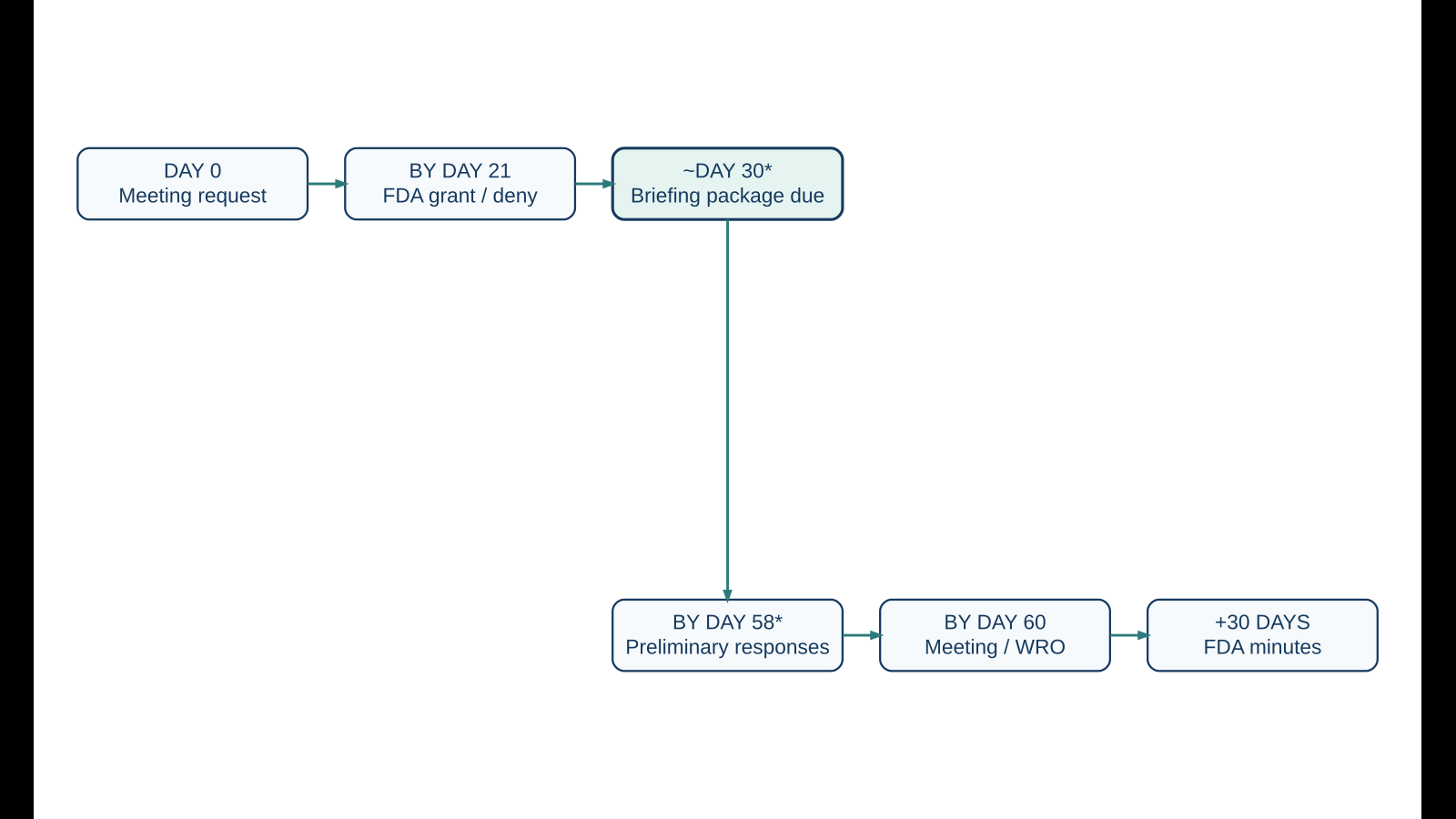
FDA meeting timeline planning for a standard Type B pre-IND interaction is more compressed than it first appears. FDA’s current goals are to respond to the meeting request within 21 calendar days and hold the meeting or issue a written response within 60 calendar days. The Type B meeting package is due no later than 30 calendar days before the scheduled meeting or WRO response time.
That creates an important sponsor-side consequence: if the meeting is scheduled on Day 60, the package is due around Day 30. Waiting for FDA’s Day-21 grant letter before starting the briefing package can leave only about nine calendar days for final authoring, cross-functional review, executive decisions, QC, and submission.
Quick answer: what is the Type B pre-IND meeting timeline?
| Milestone | Standard Type B timing | Sponsor implication |
|---|---|---|
| Meeting/WRO request received | Day 0 | FDA clock begins; sponsor package work should already be active |
| FDA grant/deny response | Within 21 calendar days | Confirm meeting date/format, FDA disciplines, and final package plan |
| Meeting package due | No later than 30 days before meeting/WRO | For a Day-60 meeting, this is approximately Day 30 |
| Meeting or WRO | Within 60 calendar days from request | Meeting date drives the package deadline |
| FDA preliminary responses for Type B meeting | No later than 2 calendar days before the meeting | Rapidly triage resolved vs. discussion-needed questions and revise agenda |
| FDA official minutes | Within 30 calendar days after the meeting | Reconcile decisions and action items against internal notes |
Who this timeline is for
This FDA meeting timeline is for CEOs, CMOs, Heads of Regulatory Affairs, clinical-development leaders, program managers, and medical/regulatory writers preparing for a pre-IND or other formal FDA interaction. It is most useful for lean sponsor teams where Clinical, Nonclinical, CMC, Statistics, Regulatory, and executive reviewers must deliver inputs on a shared critical path.
1. Before Day 0: build the package backbone before submitting the request
The highest-risk timeline mistake is treating the FDA meeting request as the start of briefing-package authoring. The request should instead be the point at which the team already understands why the meeting is needed, what decisions depend on FDA feedback, and which questions are likely to survive final prioritization.
Before Day 0, the sponsor should have:
- A defined meeting objective and decision list.
- A prioritized question inventory grouped by FDA discipline.
- Preliminary sponsor positions for each major question.
- A source register for the clinical, nonclinical, CMC, statistical, and regulatory evidence that will support those positions.
- Named authors, reviewers, approval owners, and a final QC owner.
- A realistic plan for data cutoffs, late inputs, and submission publishing.
If the team is still deciding what belongs in the package, use the companion guide on how to organize a pre-IND meeting briefing package. If the question set is the unstable element, use the guide on drafting focused FDA meeting questions.
2. Day 0: submit a request that can support the package that follows
The meeting request should give FDA enough information to understand the purpose of the interaction, identify the appropriate disciplines, assess whether the meeting is useful, and determine the meeting format and timing. The proposed questions, agenda, objectives, participants, and planned package date should all be internally consistent with the package the sponsor expects to submit.
Do not use Day 0 as a soft strategy deadline. If the request contains questions that the sponsor does not actually intend to defend in the package, later revisions can create avoidable churn in authoring, review ownership, and FDA preparation.
3. Days 0-21: use FDA’s response window as the main authoring sprint
For a standard Type B meeting, FDA’s response goal is 21 calendar days from receipt of the request. This period should not be treated as waiting time. It is the sponsor’s main authoring sprint.
| Workstream | What should move during Days 0-21 | Owner |
|---|---|---|
| Question strategy | Refine scope, sponsor position, evidence, and decision consequence for each question | Regulatory + functional leads |
| Package narrative | Draft program background and discipline sections around the question set | Medical/regulatory writer |
| Source control | Lock document versions, data cutoffs, tables, figures, and prior FDA correspondence | Functional source owners |
| Cross-functional review | Resolve technical disagreements before executive wording review | Program lead + SMEs |
| Publishing readiness | Plan document QC, hyperlinks, numbering, file structure, and electronic submission route | Regulatory operations / publishing |
4. Day 21: treat the FDA response as a decision gate, not a writing kickoff
When FDA grants the meeting or WRO, the response identifies the date and format. The sponsor should immediately calculate the real package deadline from the scheduled date and rebaseline the internal plan.
If a Type B meeting is scheduled on Day 60, a package due 30 days before the meeting falls around Day 30. That leaves roughly nine calendar days after the Day-21 response goal. Those nine days should be reserved for controlled finalization—not first-draft authoring.
Day-21 decision gate
- Confirm the scheduled meeting/WRO date and calculate the package due date.
- Confirm whether any change in format affects preparation or attendee needs.
- Reconcile the question set against the granted interaction.
- Freeze or explicitly escalate any unresolved sponsor positions.
- Approve the final authoring/review calendar through submission.
5. Days 21-30: protect the package finalization window
The finalization window should focus on integration and control. A new data table, question, or scientific position added late can affect several sections at once and trigger a second review cycle. Late additions therefore need a defined decision owner and a clear test: does this information materially improve FDA’s ability to answer an existing question?
A practical critical path for this window is:
- Question freeze: lock the final question numbering, scope, and sponsor positions.
- Integrated draft: reconcile narrative, tables, figures, and cross-references against the same source versions.
- Executive/functional approval: resolve substantive issues, not copyediting preferences.
- QC: verify data consistency, terminology, pagination, links, question numbering, prior FDA advice, and source traceability.
- Submission readiness: confirm the correct application/meeting reference, electronic submission route, final files, and delivery ownership.
If the sponsor needs a dedicated integration layer across these activities, BioBoston CRO provides FDA Briefing Book Writing support for complete packages, selected sections, existing-draft revision, cross-functional integration, and independent QC.
6. Do not reuse the Type B dates for every FDA meeting
An FDA meeting timeline changes by meeting type. FDA’s current formal-meetings framework uses different response, scheduling, and package timelines for Type B, Type B end-of-phase, Type C, Type D, and INTERACT meetings.
| Meeting type | FDA response goal | Meeting/WRO timing | Package timing |
|---|---|---|---|
| Type B | 21 days | Within 60 days | No later than 30 days before meeting/WRO |
| Type B (EOP) | 14 days | Within 70 days | No later than 50 days before meeting/WRO, subject to guidance exception |
| Type C | 21 days | Within 75 days | Generally no later than 47 days before meeting/WRO, with specific exceptions |
Build the project plan from the meeting type actually requested and the date FDA actually grants. A generic “60-day FDA meeting plan” can create the wrong internal deadlines for other interaction types.
7. Watch for delay signals before they become deadline problems
| Delay signal | Why it matters | Mitigation |
|---|---|---|
| Questions still changing after Day 21 | Changes can cascade into evidence, narrative, agenda, and review | Escalate to one decision owner; freeze scope unless the change is material |
| Uncontrolled data cutoff | Tables and conclusions can become inconsistent across sections | Set a package data cutoff and formal late-data exception process |
| No single integrated owner | Functional drafts can conflict without anyone resolving cross-document issues | Assign one package lead with authority to drive integration |
| Executive review starts at final QC | Strategic comments arrive when only formatting time remains | Schedule sponsor-position approval before the QC window |
| Submission mechanics are untested | A complete document can still miss the deadline operationally | Confirm route, application identifiers, file requirements, and publishing owner early |
8. What happens after package submission?
For Type B meetings other than Type B end-of-phase, FDA intends to provide preliminary responses no later than two calendar days before the meeting. The sponsor should quickly decide which questions are resolved and which require discussion, then send a revised agenda if the meeting is still needed. FDA issues official finalized meeting minutes within 30 calendar days after the meeting.
The FDA meeting timeline does not end at package submission. The sponsor still needs a short response-management plan for preliminary answers, meeting roles, live decision capture, and reconciliation of FDA minutes with internal action items.
FDA meeting timeline: sponsor readiness checklist
- The meeting objective and decision list are defined before Day 0.
- The package backbone exists before the request is submitted.
- Questions are prioritized and grouped by FDA discipline.
- Source owners and data cutoffs are documented.
- Days 0-21 are used as an authoring sprint, not waiting time.
- The package deadline is recalculated immediately from FDA’s granted meeting date.
- Late scientific changes require a named decision owner.
- Executive approval occurs before final QC.
- Regulatory operations/publishing steps are confirmed before the submission window.
- The team has a plan for FDA preliminary responses and the revised agenda.
Need help managing the FDA meeting critical path?
Explore BioBoston CRO FDA Briefing Book Writing support for a controlled package timeline that connects question strategy, source readiness, cross-functional review, document integration, QC, and submission.